AI in Education: Personalized Learning at Scale Is Transforming How Students Learn
AI is reshaping education at every level — from kindergarten classrooms to postgraduate programs — with personalized learning systems that adapt in real-time to each student’s pace, knowledge gaps, and learning style. What was once a one-size-fits-all model of education, where 30 students received identical instruction regardless of their individual needs, is giving way to AI-powered platforms that provide each learner with a customized educational path. The results are promising but raise fundamental questions about the role of teachers, the nature of assessment, and the equity of access to technology-enhanced education.
How AI Personalized Learning Works
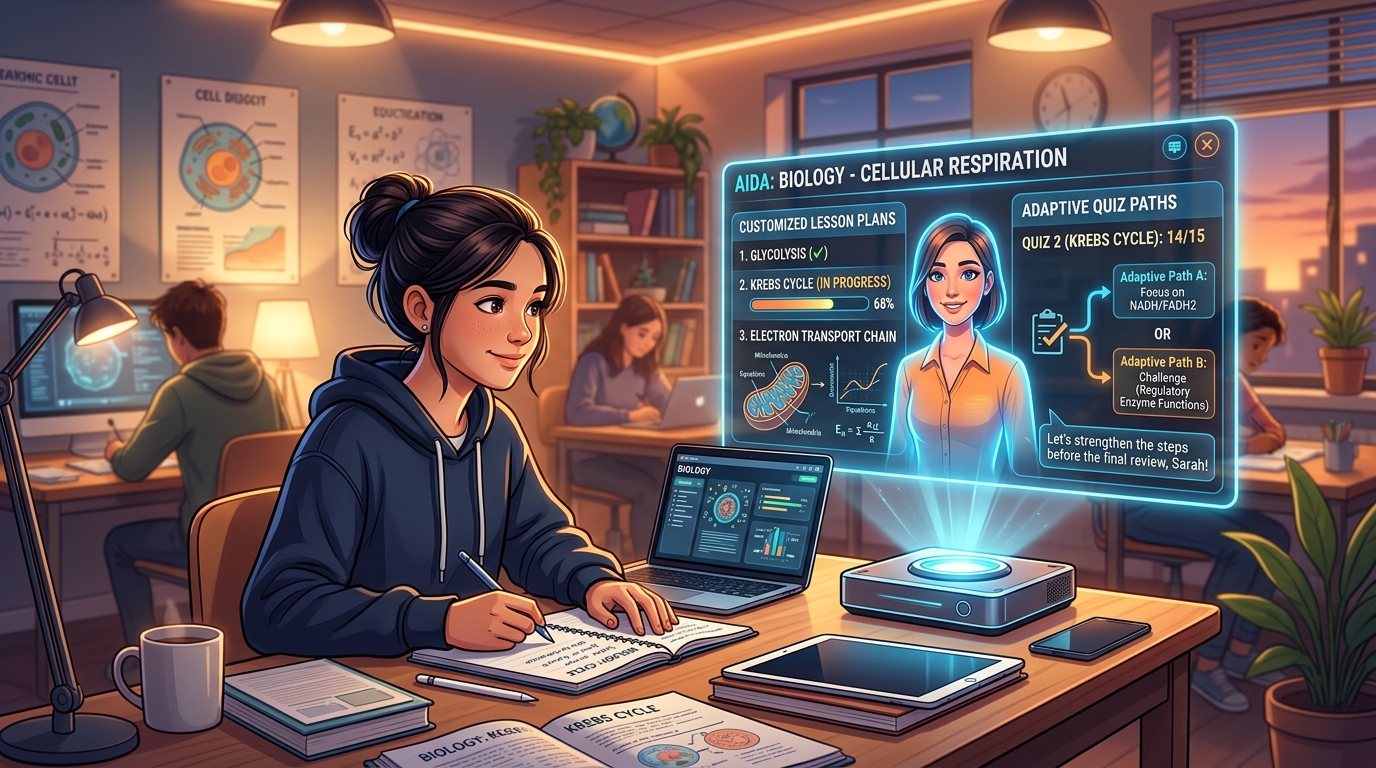
Modern AI tutoring systems work by building a dynamic model of each student’s knowledge state. As a student works through problems, reads material, or answers questions, the AI continuously updates its understanding of what the student knows, what they’re struggling with, and how they learn best. This student model drives adaptive content selection — the system chooses the next problem, explanation, or activity based on what will most effectively advance the student’s understanding at that particular moment.
The underlying technology combines several AI techniques. Natural language processing allows students to ask questions in plain language and receive explanations tailored to their grade level and context. Knowledge graphs map the relationships between concepts in a subject area, enabling the AI to identify prerequisite knowledge gaps when a student struggles with an advanced topic. Reinforcement learning optimizes the sequence and difficulty of practice problems to maximize long-term retention while minimizing frustration. And large language models provide the ability to generate novel explanations, analogies, and examples on demand — not recycling a fixed library of pre-written content but creating fresh explanations matched to each student’s specific confusion.
Khan Academy’s Khanmigo, powered by OpenAI’s GPT models, exemplifies the current generation. Rather than simply providing answers, Khanmigo engages in Socratic dialogue — asking guiding questions that lead students to discover solutions themselves. When a student gets stuck on an algebra problem, Khanmigo doesn’t solve it; instead, it identifies the specific step where the student’s reasoning diverges from correct methodology and asks a targeted question that illuminates the error. This approach mirrors what the best human tutors do, but at a scale no human tutoring system could achieve.
Measured Impact on Learning Outcomes
The evidence for AI-enhanced learning effectiveness is growing but not yet definitive. A large-scale randomized controlled trial by the Department of Education involving 15,000 middle school students in 150 schools found that students using AI tutoring systems for math showed a 12 percentile point improvement in standardized test scores compared to control groups receiving traditional instruction — roughly equivalent to moving from the 50th to the 62nd percentile, or gaining approximately one additional year of learning over the study period.
The gains were not evenly distributed. Students in the bottom quartile of prior achievement showed the largest improvements (18 percentile points), while top-quartile students showed modest gains (5 percentile points). This pattern suggests that AI tutoring is particularly effective at remediation and catching up students who have fallen behind — providing the individualized attention that struggling learners need but rarely receive in large classroom settings where teachers must divide attention among many students.
Language learning shows some of the most dramatic AI-assisted improvements. Duolingo’s AI-powered features — including conversational practice with AI characters, automatic speech assessment, and personalized lesson optimization — have contributed to what Duolingo reports as a 40% improvement in user language proficiency test scores compared to the pre-AI version of the platform. The conversational practice feature is particularly impactful because it provides unlimited speaking practice with real-time feedback — an opportunity that learners previously could only get from a human tutor or language exchange partner.
Higher education is seeing adoption in a different mode. University courses are using AI systems to provide personalized feedback on essays, problem sets, and lab reports at a scale and speed that human teaching assistants cannot match. Georgia Tech’s AI teaching assistant “Jill Watson” (based on IBM Watson, later rebuilt on LLMs) has been handling routine student questions in online courses since 2014, and the latest version handles 80% of student inquiries without human intervention. Students consistently rate Jill’s responses as helpful and often don’t realize they’re interacting with an AI — a measure of how natural the interaction has become.
The Teacher’s Evolving Role
The most contentious question in AI education isn’t technical — it’s philosophical: what is the role of a teacher when AI can deliver personalized instruction? The answer emerging from schools that have thoughtfully integrated AI is that teachers become orchestrators and mentors rather than primary content deliverers. The AI handles differentiated instruction (teaching the same concept at different levels simultaneously), immediate feedback (no more waiting days for graded assignments), and data collection (identifying which students are struggling and with what specific concepts). The teacher handles what AI cannot: inspiring curiosity, facilitating group discussions, building social-emotional skills, mentoring individual students through personal challenges, and curating the learning experience.
Teachers using AI tools report spending significantly less time on repetitive tasks — grading routine assignments, answering frequently asked questions, creating differentiated worksheets — and more time on high-value interactions: one-on-one conversations with struggling students, project-based learning activities, and classroom discussions where human facilitation is essential. A 2025 survey by the Rand Corporation found that teachers using AI assistants reported a 30% reduction in time spent on administrative and grading tasks and a corresponding increase in time available for direct student interaction.
Not all teachers embrace the shift. Concerns about over-reliance on technology, the depersonalization of education, and the potential for AI to embed biases in educational content are legitimate and widely shared. Veteran teachers note that the relationship between a teacher and student — built on trust, empathy, and genuine human connection — is an irreplaceable component of effective education that no AI system can provide. The schools achieving the best results with AI are those that treat it as a tool to amplify human teaching, not replace it.
The Equity Challenge
AI’s potential to improve educational outcomes creates a troubling equity dynamic if access is unevenly distributed. Schools in affluent districts are more likely to have the infrastructure (reliable internet, modern devices, IT support) and funding (subscriptions to premium AI platforms, teacher training programs) needed to effectively deploy AI learning tools. A student with access to a sophisticated AI tutor at home and at school has a significant advantage over one without — potentially widening rather than narrowing achievement gaps.
The digital divide in education mirrors broader patterns of technology access. While 95% of US schools have some form of internet access, only 67% of schools in low-income districts have the bandwidth and device density needed for classroom-wide AI-assisted learning. Rural schools face additional challenges with connectivity speed and reliability. Internationally, the disparities are far greater — in sub-Saharan Africa and South Asia, where AI-enhanced education could have the greatest impact on learning outcomes, fewer than 30% of schools have adequate internet access.
Several initiatives are working to close this gap. Khan Academy provides Khanmigo free to all US teachers through philanthropic funding. Google provides Chromebooks and internet access to underserved schools through its education initiatives. The Bill and Melinda Gates Foundation has invested $350 million in AI education tools specifically targeting low-income communities. But the scale of the equity challenge dwarfs current philanthropic efforts — systemic solutions require public funding comparable to what’s spent on textbooks and physical classroom infrastructure.
Assessment and Integrity in an AI World
When students have access to AI that can write essays, solve math problems, and generate code, traditional assessment methods become problematic. A take-home essay assignment is no longer a reliable measure of writing ability when ChatGPT can produce competent prose in seconds. An online exam with access to AI tools tests different skills than the same exam without them. The entire framework of academic assessment — designed for a world where students demonstrate individual mastery through independent work — must be rethought.
Schools and universities are adapting through several strategies. Oral examinations and live demonstrations are replacing some written assessments, since AI can’t take an in-person exam on a student’s behalf. Process-based assessment — evaluating how a student arrives at an answer, including their revision history, research notes, and metacognitive reflections — provides insights that a final product alone cannot. AI-inclusive assessments explicitly allow and expect AI tool use, evaluating students on their ability to effectively direct AI, critically evaluate its output, and integrate AI-generated content with their own analysis — skills that are arguably more valuable in professional contexts than unassisted writing or problem-solving.
Academic integrity detection tools have evolved alongside AI writing capabilities. Turnitin’s AI writing detection feature claims 98% accuracy in identifying AI-generated text, but false-positive rates remain concerning — particularly for non-native English speakers whose writing patterns can resemble AI-generated text. The fundamental challenge is that detection will always be an arms race against improving generation technology, and policies based solely on detection are unsustainable. The more promising approach is redesigning assessment to make AI use transparent and evaluated rather than prohibited and policed.
The Future of AI in Education
Looking ahead, several developments will shape AI’s educational impact. Multimodal AI tutors that can see a student’s handwritten work through a camera, hear their verbal explanations, and provide real-time coaching are already in prototype. AI systems that collaborate with teachers to co-design lesson plans based on class-wide knowledge gaps (identified through continuous assessment data) are being piloted in several school districts. Immersive AI-guided experiences using VR — walking through ancient Rome with an AI guide, exploring the inside of a cell with an AI biology tutor — are moving from concept to early commercial availability.
The trajectory is toward AI as a permanent and pervasive layer in the educational stack — not replacing schools, teachers, or social learning, but augmenting them with unprecedented personalization, immediate feedback, and data-driven insights. The decisions made now about funding, access, teacher training, and assessment design will determine whether this evolution narrows or widens educational inequality. The technology is ready. The institutional and political will to deploy it equitably is the open question.
Related articles: Fintech Super Apps Dominate Emerging Mar | Neuromorphic Computing: Brain-Inspired C | 3D Bioprinting in 2026: From Lab Curiosi