
Matter Protocol in 2026: The Smart Home Interoperability Standard That’s Actually Working
The smart home industry has spent over a decade promising seamless interoperability — the idea that any device from any manufacturer would work with any hub, voice assistant, or automation system. The reality has been a fragmented mess of incompatible ecosystems: devices that only work with Alexa, or only with HomeKit, or only with Google Home; proprietary protocols like Zigbee, Z-Wave, and Wi-Fi competing for shelf space; and consumers stuck in vendor-specific silos where adding a new smart light bulb requires checking compatibility before checking price. The Matter protocol, developed by the Connectivity Standards Alliance (formerly the Zigbee Alliance) with backing from Apple, Amazon, Google, Samsung, and virtually every major smart home company, is the industry’s most ambitious attempt to fix this — and after a rocky launch, it’s finally starting to deliver on the promise.
What Matter Actually Does
Matter is an application-layer protocol that provides a unified standard for how smart home devices communicate. A Matter-certified smart plug, light bulb, thermostat, or door lock can be controlled by any Matter-compatible platform — Apple HomeKit, Amazon Alexa, Google Home, Samsung SmartThings, and others — without needing platform-specific firmware, apps, or cloud accounts. You buy a Matter device, scan a QR code with any compatible app, and it joins your smart home. No more checking compatibility matrices or installing manufacturer-specific apps.
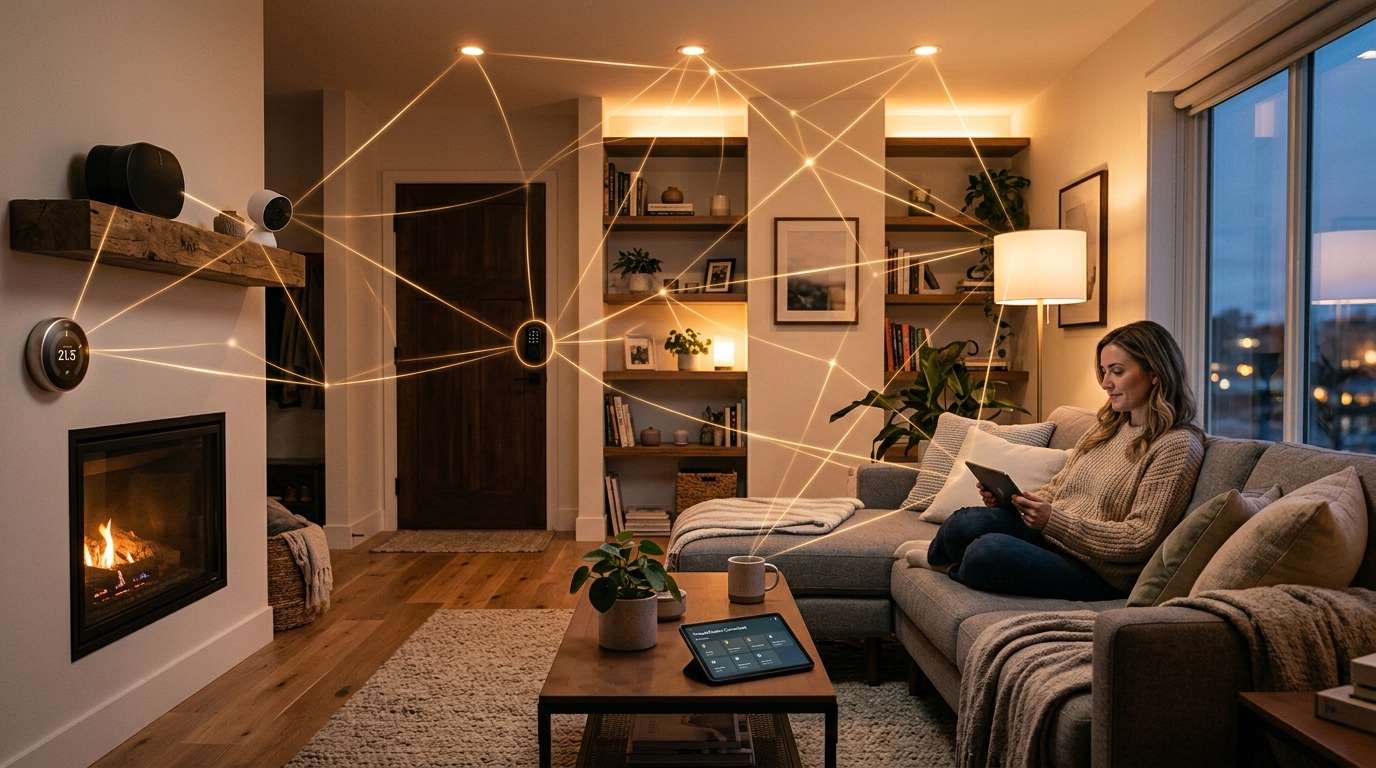
Under the hood, Matter runs over three transport protocols: Wi-Fi (for high-bandwidth devices like cameras and displays), Thread (a low-power mesh networking protocol for battery-operated devices like sensors and locks), and Ethernet (for wired devices). All three transports are IP-based, meaning Matter devices are standard network clients that communicate using the same fundamental internet protocols as your phone and laptop. This IP foundation is crucial because it eliminates the need for proprietary hubs and bridges — Matter devices communicate directly over your home network rather than requiring device-specific gateways.
Thread, in particular, is a technology that Matter has elevated from obscurity to mainstream relevance. Thread is a low-power, self-healing mesh network designed specifically for IoT devices. Unlike Wi-Fi, which is power-hungry and not designed for devices running on button cell batteries, Thread enables battery-operated sensors, locks, and switches to run for years without battery changes. Thread devices form a mesh network where each mains-powered device acts as a router, forwarding messages for battery-operated devices and providing redundant communication paths. If one Thread device fails, the mesh automatically routes around it.
Thread border routers — which connect the Thread mesh network to your Wi-Fi and internet — are already built into many existing devices. Apple HomePod Mini, Apple TV 4K, Google Nest Hub (2nd gen), Amazon Echo (4th gen), and various SmartThings hubs all function as Thread border routers. Most consumers already have at least one in their home, meaning they can add Thread-based Matter devices without buying additional hardware.
The Rocky Launch and Iterative Progress
Matter 1.0 launched in October 2022 with support for a limited set of device types: lights, switches, plugs, thermostats, door locks, and window blinds. The initial launch was met with mixed reactions. The device selection was seen as too basic — notable absences included cameras, robot vacuums, appliances, and most sensor types. Commissioning (the setup process) was sometimes unreliable, with devices failing to connect or taking multiple attempts. Some early Matter devices had firmware bugs that caused disconnections or failed automations.
The protocol has improved significantly through iterative updates. Matter 1.1 (May 2023) improved commissioning reliability and added features for professional installers. Matter 1.2 (October 2023) added support for nine new device types including robot vacuums, refrigerators, washing machines, dishwashers, smoke detectors, air quality sensors, and air purifiers. Matter 1.3 (May 2024) added energy management devices, water management, electric vehicle chargers, and microwave ovens. Matter 1.4 (November 2024) brought enhanced multi-admin device management and improved Thread network reliability.
The current iteration, as of early 2026, supports over 40 device categories covering the vast majority of common smart home devices. Security cameras — the most requested missing category — are expected in a forthcoming update. Each release has also improved reliability, setup speed, and interoperability between platforms. The Matter standard has reached the point where newly purchased Matter devices generally “just work,” though the experience with older Matter 1.0 firmware devices is less consistent.
The Ecosystem Today
Over 1,500 Matter-certified products are now available, from major brands including Philips Hue, Yale, Aqara, Eve, Nanoleaf, Lutron, Belkin, TP-Link, and dozens more. Philips Hue’s decision to add Matter support to its entire smart lighting lineup — the most popular smart lighting brand globally — was a watershed moment that gave consumers a compelling reason to care about Matter compatibility. Yale’s Matter-enabled smart locks allow users to grant and revoke access through any platform rather than being locked into the Yale app.
The platform experience varies. Apple HomeKit’s Matter support is widely regarded as the most polished, largely because Apple was an early champion of the IP-based approach that became Matter and had the longest head start on integration. Google Home’s Matter implementation has improved substantially through updates, though some users report occasional commissioning issues. Amazon Alexa’s Matter support is functional but has been slower to mature, with some device types and automations not yet fully supported. Samsung SmartThings provides the most flexible Matter hub, supporting the widest range of device-specific capabilities beyond the standard Matter feature set.
Multi-admin is one of Matter’s most consumer-friendly features. A single Matter device can be controlled by multiple platforms simultaneously — you can add the same light bulb to both Apple HomeKit and Amazon Alexa, allowing household members with different platform preferences to control the same devices through their preferred interface. This eliminates the “whose ecosystem do we use?” conflict that many mixed-platform households experience with traditional smart home devices.
Thread’s Growing Importance
Thread is emerging as the most important wireless protocol for the smart home, and Matter’s adoption of Thread as a primary transport is driving rapid network effects. Every mains-powered Thread device strengthens the mesh network, improving coverage and reliability for all other Thread devices. A household with 10-15 Thread devices (smart bulbs, switches, plugs) creates a robust mesh that covers the entire home, providing reliable connectivity for battery-operated sensors and locks positioned far from the Wi-Fi router.
Thread’s low-power consumption is transformative for battery-operated devices. Traditional Zigbee and Z-Wave sensors and locks typically last 1-2 years on batteries. Thread-based devices using the Sleepy End Device (SED) protocol can achieve 5+ year battery life on a single coin cell because Thread’s communication efficiency minimizes the time a device spends with its radio active. This extended battery life makes smart sensors practical for more use cases — you can place temperature sensors, door sensors, and motion detectors throughout your home without the maintenance burden of frequent battery replacement.
The Thread network’s self-healing mesh topology provides reliability that centralized protocols can’t match. In a Wi-Fi smart home, the router is a single point of failure — if the router goes down or if a device is too far from the router, the device becomes unreachable. In a Thread mesh, messages can take any path through the mesh to reach their destination. If one router node fails, messages automatically route through other nodes. This resilience means that Thread-based smart homes degrade gracefully rather than failing entirely when individual devices have issues.
Challenges Remaining
Despite significant progress, Matter faces several ongoing challenges. Migration of existing devices is a pain point. Consumers who have invested hundreds or thousands of dollars in existing smart home devices (Zigbee-based Phillip Hue bulbs, Z-Wave locks, Wi-Fi-based smart plugs) can’t simply update firmware to gain Matter compatibility in most cases. Some manufacturers offer firmware updates for newer hardware (Philips Hue, Eve, Nanoleaf), but many older devices will never receive Matter support. This creates a long transition period where consumers operate mixed ecosystems of Matter and non-Matter devices.
Bridge devices help with backward compatibility. The Philips Hue Bridge, for example, exposes older Zigbee-based Hue bulbs as Matter devices, allowing them to be controlled through Matter-compatible platforms. Aqara’s M2 Hub bridges Zigbee devices to Matter. These bridges add cost and complexity but provide a path for existing device investments to participate in the Matter ecosystem.
Advanced automations and device-specific features remain platform-dependent. While Matter standardizes basic device control (turn on/off, set brightness, set temperature), sophisticated automations that combine multiple device states, time-based triggers, and conditional logic are still handled by each platform’s proprietary automation engine (Apple HomeKit Automations, Google Home Routines, Alexa Routines). There’s no Matter-standard automation protocol — a gap that limits the “set it up once and it works everywhere” promise for power users.
Response time for Thread devices, while generally good, can be slightly slower than dedicated Zigbee or Z-Wave networks in some configurations. Thread devices controlled through Matter must traverse the Thread mesh to a border router, then through the home network to the controlling platform, then back through the same path. This round-trip can add 100-300ms compared to direct Zigbee control through a hub, which is perceptible for latency-sensitive operations like light switches where users expect instant response.
The Future Trajectory
Matter’s trajectory is clearly toward becoming the default standard for smart home devices within the next 3-5 years. The combined backing of Apple, Amazon, Google, and Samsung — companies that collectively control virtually all smart home platforms — makes Matter the first interoperability standard with enough industry support to actually achieve universal adoption. New smart home devices launched without Matter support will increasingly face a competitive disadvantage as consumers learn to expect cross-platform compatibility.
The addition of security cameras to Matter (expected in version 1.5 or 1.6) will fill the most significant gap in the standard’s device coverage. Cameras are the most popular smart home device category, and their inclusion in Matter will bring the protocol to the mainstream consumer consciousness in a way that light bulbs and sensors haven’t.
For consumers, the practical advice is straightforward: when purchasing new smart home devices, prioritize Matter certification. The devices will work with whatever platform you currently use and will remain compatible if you switch platforms in the future. The upfront premium for Matter devices (typically $5-$15 more than non-Matter equivalents) is a worthwhile investment in future-proofing and interoperability. The smart home’s fragmentation era is ending — not instantly, but visibly and irreversibly.
Related articles: Fintech Super Apps Dominate Emerging Mar | Neuromorphic Computing: Brain-Inspired C | 3D Bioprinting in 2026: From Lab Curiosi