
Supply Chain AI: How Machine Learning Is Preventing the Next Global Disruption
Supply chain disruptions have become a permanent feature of the global economy — a lesson reinforced by the pandemic, the Suez Canal blockage, the Red Sea shipping crisis, semiconductor shortages, and climate-driven agricultural disruptions. The response from industry is a massive investment in AI-powered supply chain management that promises to predict disruptions before they happen, optimize inventory and logistics in real-time, and automate decisions that human planners cannot make fast enough. The global supply chain AI market reached $8 billion in 2025 and is projected to exceed $30 billion by 2030, as companies shift from reactive crisis management to proactive, AI-driven supply chain resilience.
Predictive Disruption Intelligence
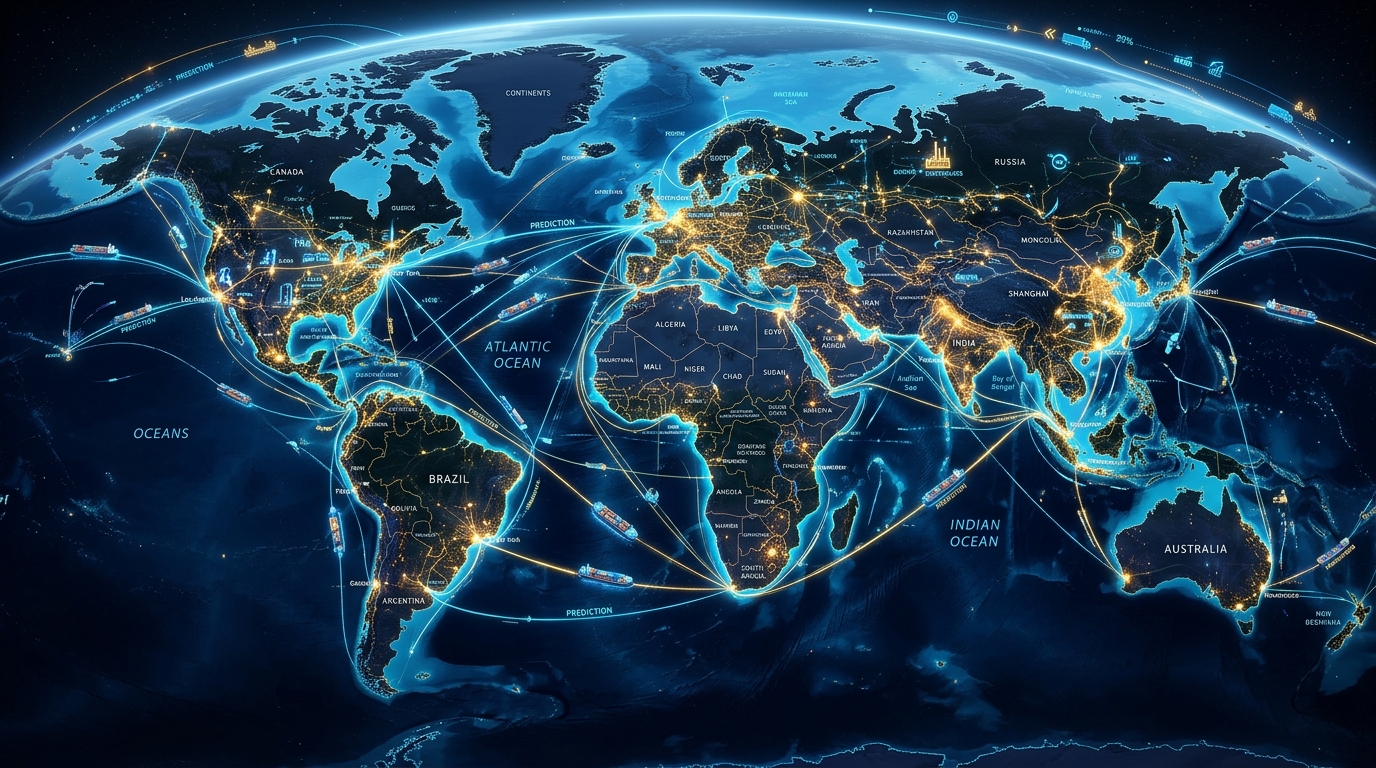
The most immediately valuable application of AI in supply chains is predicting disruptions before they cascade into stockouts, production shutdowns, or delivery failures. Traditional supply chain management is reactive: a disruption occurs (a port closes, a supplier goes bankrupt, a storm damages a warehouse), and supply chain managers scramble to find alternatives. AI-powered predictive systems monitor thousands of real-time data feeds — shipping vessel positions, port congestion levels, weather patterns, geopolitical events, social media signals, supplier financial health indicators, commodity prices, and trade policy announcements — and flag potential disruptions days to weeks before they materialize.
Everstream Analytics, one of the leading supply chain risk intelligence platforms, processes data from over 300,000 sources to predict supplier risk, transportation disruptions, and demand shifts. Their platform predicted the Red Sea shipping crisis (Houthi attacks on commercial vessels in late 2023) several weeks before it disrupted global shipping lanes, enabling their clients to reroute shipments and adjust inventory positions before the crisis peaked. This kind of early warning is worth millions in avoided stockouts and expediting costs for large manufacturers and retailers.
Altana AI provides a “digital twin” of the global supply chain — a comprehensive map of supplier relationships, trade flows, and component dependencies built from customs records, shipping data, satellite imagery, and corporate filings. This visibility enables companies to identify hidden dependencies: discovering that their tier-3 supplier (the supplier’s supplier’s supplier) sources a critical component from a single factory in a politically unstable region, even when the tier-1 supplier is unaware of this dependency. Such hidden concentration risks caused many of the pandemic-era supply chain failures, and mapping them is essential for building genuine resilience.
Climate risk prediction is an increasingly important input to supply chain AI. Machine learning models that combine weather forecast data, historical climate patterns, crop yield models, and infrastructure vulnerability assessments can predict when extreme weather events are likely to disrupt agricultural supply chains, transportation networks, or manufacturing operations. Companies including Jupiter Intelligence and ClimateAi provide AI-driven climate risk assessments specifically for supply chain applications, enabling companies to diversify sourcing away from climate-vulnerable regions before disasters occur.
Demand Forecasting: Beyond Spreadsheets
AI-powered demand forecasting has replaced the spreadsheet-based forecasting models that most companies relied on until recently. Traditional demand planning uses historical sales data, seasonal patterns, and planner intuition to project future demand — an approach that works reasonably well for stable, predictable products but breaks down for new products, trend-driven categories, and volatile markets affected by external factors (weather, economic conditions, social media trends, competitor actions).
Machine learning demand forecasting ingests far more data: historical sales at SKU/location/day granularity, pricing and promotional calendars, weather forecasts, local events and holidays, competitor pricing and availability, social media sentiment and search trends, economic indicators, and even satellite-derived parking lot traffic data (as a proxy for retail foot traffic). Models trained on this rich feature set typically reduce forecast error by 20-40% compared to traditional statistical methods, which translates directly to reduced overstock (and markdown losses), reduced stockouts (and lost sales), and lower safety stock requirements (and inventory carrying costs).
Amazon’s demand forecasting system, which the company has published research papers about, uses deep learning models that process billions of data points across millions of products to predict demand at hourly granularity for each fulfillment center. This granular forecasting enables Amazon’s legendary same-day and next-day delivery by positioning inventory at the right fulfillment centers before orders are placed. The forecasting system’s accuracy enables Amazon to ship products closer to customers without holding excessive inventory — a capability that is a significant competitive moat.
The most sophisticated demand forecasting systems incorporate causality rather than just correlation. Understanding that a marketing campaign causes a demand increase (rather than merely coinciding with one) enables more accurate planning for future campaigns. Causal machine learning, a rapidly advancing field, provides models that can distinguish correlation from causation in complex multi-variable environments, improving the reliability of demand forecasts in situations where traditional ML models would learn spurious correlations.
Autonomous Planning and Replenishment
AI is moving supply chain planning from human-driven decision-making to autonomous systems that plan, decide, and execute with minimal human intervention. Automated replenishment systems determine when and how much to reorder for each product at each location, generating purchase orders and distribution plans continuously rather than in weekly planning cycles.
Blue Yonder (formerly JDA), one of the largest supply chain software providers, offers an AI-driven “autonomous supply chain” platform that handles demand sensing (real-time demand signal processing), inventory optimization (determining optimal stock levels across the network), and automated replenishment (generating orders when stock levels trigger reorder points). The system processes millions of SKU-location combinations simultaneously and adjusts plans in real-time as conditions change — a scale and speed of decision-making that human planners cannot match.
Digital twin technology creates virtual replicas of the entire supply chain network — factories, warehouses, transportation routes, retail locations — that can be used to simulate scenarios and optimize decisions before implementing them in the real world. A digital twin enables questions like: “What happens to delivery times if we add a warehouse in Dallas?” or “How does switching from ship to rail for the Asia-to-US leg affect cost and delivery reliability?” to be answered through simulation rather than expensive real-world experimentation. NVIDIA’s Omniverse platform and Microsoft’s Azure Digital Twins provide infrastructure for building these supply chain simulations.
Warehouse and Logistics Automation
AI is transforming the physical operations of supply chains through warehouse robotics, route optimization, and autonomous vehicles. Amazon deploys over 750,000 mobile robots across its fulfillment centers, handling goods storage, retrieval, and transport. These robots use AI for navigation, collision avoidance, task scheduling, and coordinated movement — enabling warehouse throughput that manual operations cannot match while reducing ergonomic injuries from repetitive lifting and carrying.
Route optimization for delivery fleets uses AI to solve the vehicle routing problem (VRP) — determining the optimal sequence of deliveries for each vehicle in a fleet, considering distances, traffic patterns, time windows, vehicle capacity, and driver hours. The VRP is a computationally complex problem (NP-hard in mathematical terms, meaning that finding the optimal solution for large instances is prohibitively expensive), and AI-powered heuristic solvers produce near-optimal solutions in seconds rather than the hours or days that exact solvers require. Companies like Google Cloud (using Google Maps data) and Route4Me provide AI-powered fleet routing that reduces fuel consumption, delivery time, and fleet size requirements.
Autonomous trucking, while still in limited commercial deployment, is being piloted on highway routes between distribution centers. Kodiak Robotics, Aurora, and Gatik operate autonomous trucks on specific routes in the US, handling the highway segments of freight delivery while human drivers handle the more complex urban first-and-last-mile segments. These deployments are expanding the operational data needed to eventually enable fully autonomous freight delivery, which would address the chronic truck driver shortage (the American Trucking Association estimates a shortage of 80,000 drivers) and reduce the cost of long-haul freight.
Challenges and Limitations
Despite the transformative potential, AI adoption in supply chain faces significant challenges. Data quality is the most common barrier: AI models are only as good as the data they’re trained on, and supply chain data is often fragmented across multiple systems (ERP, WMS, TMS, CRM), inconsistent in format and granularity, and missing key variables. Companies that attempt to deploy AI on top of poor-quality data achieve poor results and lose confidence in the technology.
Integration complexity is another major barrier. Supply chains involve multiple organizations (suppliers, manufacturers, logistics providers, distributors, retailers) using different software systems with different data formats and different levels of digital maturity. An AI system that optimizes one company’s inventory doesn’t help if the company’s suppliers can’t share real-time capacity and lead-time data. Interoperability standards and data-sharing platforms (like the Open Manufacturing Platform and various industry-specific data exchanges) are slowly emerging but adoption is fragmented.
The human element remains essential. AI can process data at superhuman speed and detect patterns that humans miss, but it cannot replace the judgment, relationship management, and creative problem-solving that experienced supply chain professionals bring to novel situations. The most effective implementations augment human decision-making with AI insight rather than attempting to remove humans from the loop entirely. AI handles the routine optimization decisions (what to reorder, how much, when) while humans focus on strategic decisions, relationship management, and handling the unexpected situations that AI models haven’t encountered in their training data.
Ethical considerations specifically relevant to supply chain AI include algorithmic bias in supplier selection (potentially disadvantaging minority-owned or small businesses), labor displacement in warehouses and transportation, and the concentration of market power among companies with superior AI capabilities. These concerns mirror broader AI ethics debates but have supply-chain-specific dimensions that the industry is only beginning to address.