
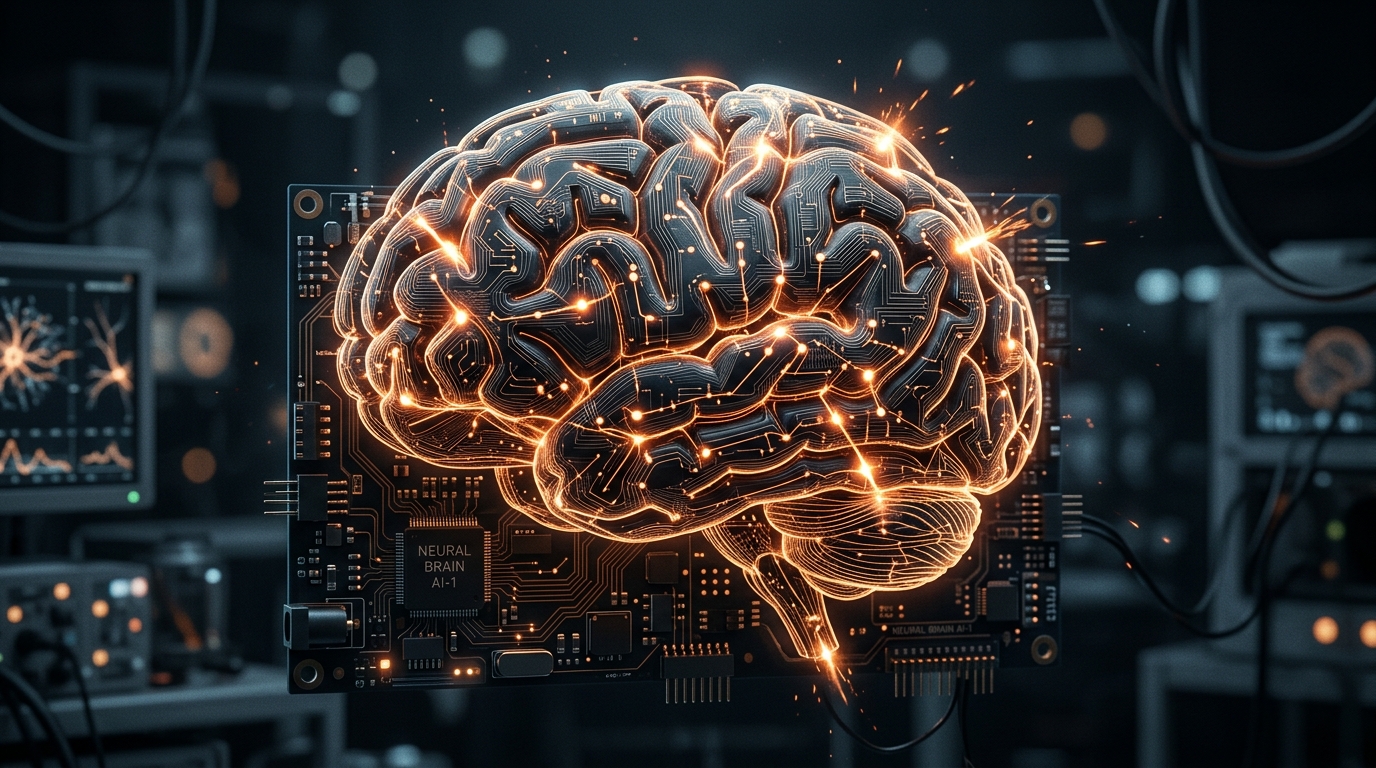
Neuromorphic Computing: Brain-Inspired Chips That Could Make AI 1000x More Efficient
Neuromorphic computing — processor architectures inspired by the structure and function of the biological brain — is emerging from research labs into commercial products that promise dramatic improvements in energy efficiency for AI workloads. While conventional processors (CPUs and GPUs) process information by shuttling data between separate memory and processing units at enormous energy cost, neuromorphic chips integrate processing and memory in the same location (mimicking how neurons both process and store information), communicating through sparse, event-driven signals (mimicking the brain’s neural spikes) rather than continuous data streams. The result is processors that can perform certain AI tasks at a fraction of the energy consumption of traditional hardware.
Why the Brain Is a Better Computer (for Some Tasks)
The human brain is the most energy-efficient known computing system for the tasks it performs. It processes visual information, recognizes patterns, makes decisions, controls movement, and maintains consciousness while consuming approximately 20 watts of power — roughly the same as a dim light bulb. An NVIDIA H100 GPU performing similar pattern recognition tasks at a comparable scale would consume 700 watts, and a data center running thousands of GPUs for AI inference consumes megawatts.
This efficiency gap stems from fundamental architectural differences. Conventional processors use the Von Neumann architecture, which separates memory (where data is stored) from processing (where computation happens). Data must be constantly moved between memory and processors through a bottleneck called the “memory bus” — a process that consumes far more energy than the actual computation. This “Von Neumann bottleneck” is the primary reason modern processors are so power-hungry: approximately 90% of the energy a GPU consumes goes to moving data around, not to performing calculations.
The brain has no such bottleneck. Neurons both store information (in the strength of their synaptic connections) and process it (by integrating incoming signals and generating output spikes). Information processing happens in place, without the need to move data between separate storage and computation units. Furthermore, neurons communicate through sparse, event-driven signals: a neuron only fires (consumes energy) when it has meaningful information to transmit. Conventional processors process every data point in a stream regardless of whether it contains meaningful information — the digital equivalent of leaving all lights on in a building rather than turning on only the lights in occupied rooms.
The Neuromorphic Architecture
Neuromorphic processors implement these brain-inspired principles in silicon. The key architectural features include: in-memory computing (processing and memory are co-located in artificial synapses, eliminating the Von Neumann bottleneck); event-driven processing (the chip only activates circuits when input data changes, consuming near-zero power during idle periods); massive parallelism (thousands to millions of simple processing units operating simultaneously, rather than a small number of complex cores); and analog-digital hybrid computation (using analog circuits for some operations, which are inherently more energy-efficient for certain mathematical functions).
Intel’s Loihi 2, the most widely available research neuromorphic processor, contains up to 1 million artificial neurons and 120 million synapses on a single chip. Each neuron is implemented as a small digital circuit that integrates incoming signals over time and generates output spikes based on configurable threshold functions. The synapses store connection weights (analogous to the strength of biological synaptic connections) locally at each neuron, enabling in-place processing. The chip’s event-driven architecture means that neurons that aren’t receiving meaningful input consume effectively zero power.
IBM’s NorthPole chip, revealed in 2023, takes a different approach: rather than mimicking biological neurons explicitly, NorthPole integrates 256 processing cores, each with its own local memory on a 12nm CMOS process, eliminating the Von Neumann bottleneck through architecture rather than biomimicry. The result is 25x better energy efficiency than a comparable GPU for AI inference tasks. IBM positions NorthPole not as a neuromorphic chip per se but as a “neural inference” chip that applies neuromorphic principles to conventional semiconductor technology.
SynSense, a startup spun out of the University of Zurich and ETH Zurich, produces neuromorphic chips (Xylo and Speck series) specifically designed for edge AI applications — keyword detection in smart speakers, gesture recognition in wearables, and visual processing in security cameras. These chips consume microwatts to milliwatts of power, enabling AI inference in battery-powered devices that would be impossible with conventional processors. A neuromorphic keyword detection chip consuming 100 microwatts can last years on a coin cell battery; a conventional processor performing the same task at 50 milliwatts would drain the battery in days.
Spiking Neural Networks: The Software Side
Neuromorphic hardware runs a fundamentally different type of neural network than the deep learning models that dominate conventional AI. Standard artificial neural networks (ANNs) — the models running on GPUs — process information as continuous numerical values, with each layer computing weighted sums and applying activation functions in synchronous forward passes. Spiking neural networks (SNNs), the computational model native to neuromorphic hardware, process information as discrete temporal events (spikes). Neurons accumulate input over time and fire a spike only when a threshold is reached, similar to how biological neurons operate.
The temporal dimension of spiking neural networks provides advantages for processing time-series data. Audio signals, event camera output, sensor streams, and any data where timing carries information are naturally represented by spikes. A neuromorphic processor receiving audio from a microphone can process the temporal pattern of sound directly, without the conversion to spectrograms or frequency-domain representations that conventional audio processing requires. This direct temporal processing is both more efficient and potentially more accurate for temporal pattern recognition tasks.
The challenge is that the deep learning ecosystem — frameworks (PyTorch, TensorFlow), training techniques (backpropagation, batch normalization), pre-trained models, and the enormous body of research and practical knowledge — is built for conventional neural networks, not spiking networks. Training effective spiking neural networks is harder: backpropagation doesn’t directly apply to spike-based computation (because spikes are discrete events, not differentiable functions), and the training tools and techniques for SNNs are less mature and less widely known.
Several approaches bridge this gap. ANN-to-SNN conversion takes a trained conventional neural network and converts it to a spiking equivalent, preserving most of the accuracy while gaining the energy efficiency of neuromorphic execution. Surrogate gradient methods approximate the non-differentiable spike function with a smooth function during training, enabling standard backpropagation-like training for SNNs. Intel’s Lava framework and SynSense’s Sinabs provide software tools specifically for developing, training, and deploying spiking neural networks on neuromorphic hardware.
Applications Where Neuromorphic Excels
Neuromorphic computing isn’t a universal replacement for conventional processors — it excels at specific workload types while being less suitable for others. The applications where neuromorphic provides the strongest advantage share several characteristics: event-driven data (where input arrives sporadically rather than in continuous streams), temporal pattern recognition (where the timing of inputs carries information), extreme power constraints (where milliwatt or microwatt power budgets preclude conventional processors), and always-on sensing (where the processor must monitor continuously but process rarely).
Smart sensors represent the most immediate commercial application. A neuromorphic-powered security camera can monitor a scene continuously at micropower consumption and only activate higher-power processing (recording, alerting, transmitting data) when a meaningful event (motion, unusual pattern, recognized face) is detected. The event-driven architecture means the chip consumes near-zero power when the scene is static and ramps up processing only for the fraction of time when something is happening — a dramatic efficiency advantage over conventional processors that continuously process every frame regardless of its information content.
Robotic control is another promising domain. Real-time sensorimotor processing — converting sensor input into motor outputs with minimal latency — maps naturally to neuromorphic architectures. Biological nervous systems perform this task with exceptional speed and efficiency, and neuromorphic processors that mimic this architecture can achieve similar performance for robotic applications. Intel has demonstrated Loihi-based robotic implementations that learn to balance, navigate, and manipulate objects with significantly lower power and latency than GPU-based equivalents.
Olfaction (electronic noses) is a niche but commercially relevant application. Detecting chemical signatures through arrays of gas sensors produces high-dimensional, temporally varying data that maps naturally to spiking neural network processing. Neuromorphic olfaction systems have demonstrated rapid identification of chemical compounds for applications including explosive detection, food quality monitoring, and medical diagnostics (detecting biomarkers in breath). The inherent efficiency of neuromorphic processing enables battery-powered portable chemical sensing that conventional hardware makes impractical.
The Integration Path: Neuromorphic as Accelerator
The most realistic near-term deployment model for neuromorphic computing is as a specialized accelerator alongside conventional processors — similar to how GPUs (specialized for parallel computation) complement CPUs (specialized for sequential, general-purpose computation). A system might use a conventional processor for general-purpose tasks and application logic, a GPU for deep learning training and high-throughput inference, and a neuromorphic accelerator for always-on sensing, event detection, and temporally-driven inference tasks.
This heterogeneous computing approach maximizes the strengths of each architecture while minimizing its weaknesses. Neuromorphic processors are not well-suited for the large matrix multiplications that dominate transformer model inference (the workload type that drives most current AI demand), but they excel at the preprocessing, event detection, and lightweight inference tasks that feed into those larger computations. In an edge AI system, a neuromorphic front-end might detect events and extract relevant features at micropower consumption, passing only the relevant data to a conventional processor for deeper analysis — dramatically reducing the total energy consumption of the system.
Market and Investment Landscape
Investment in neuromorphic computing has increased significantly as the energy cost of AI becomes a commercial and environmental concern. Intel’s neuromorphic research lab has been operating for over 15 years and has distributed Loihi chips to over 100 research institutions. IBM continues to develop neuromorphic architectures following NorthPole. BrainChip (ASX-listed) produces the Akida neuromorphic processor targeting edge AI applications. SynSense has raised over $100 million for commercial neuromorphic chips. Numerous academic labs worldwide (the Human Brain Project in Europe, university labs in the US, China, and South Korea) are advancing neuromorphic research.
The market for neuromorphic processors is projected to reach $2.4 billion by 2030 — still small compared to the $50+ billion GPU market but growing rapidly as edge AI applications scale and energy efficiency becomes a competitive differentiator. The automotive industry (low-power perception for autonomous vehicles), the IoT industry (always-on sensing for industrial and consumer applications), and the defense industry (low-SWaP-C — size, weight, power, and cost — computing for embedded systems) are the primary early markets.
The fundamental bet behind neuromorphic computing is that as AI becomes pervasive — embedded in every device, every sensor, every interaction — the energy cost of conventional AI hardware becomes untenable. A world with trillions of connected devices, each running AI inference continuously, cannot be powered by GPU-class processing. Neuromorphic computing offers a path to AI at planetary scale without planetary-scale energy consumption — a vision that may take a decade or more to fully realize but whose foundations are being built now.