
Multi-Cloud Strategy in 2026: Why It’s Mandatory and Why It’s Still Painfully Hard
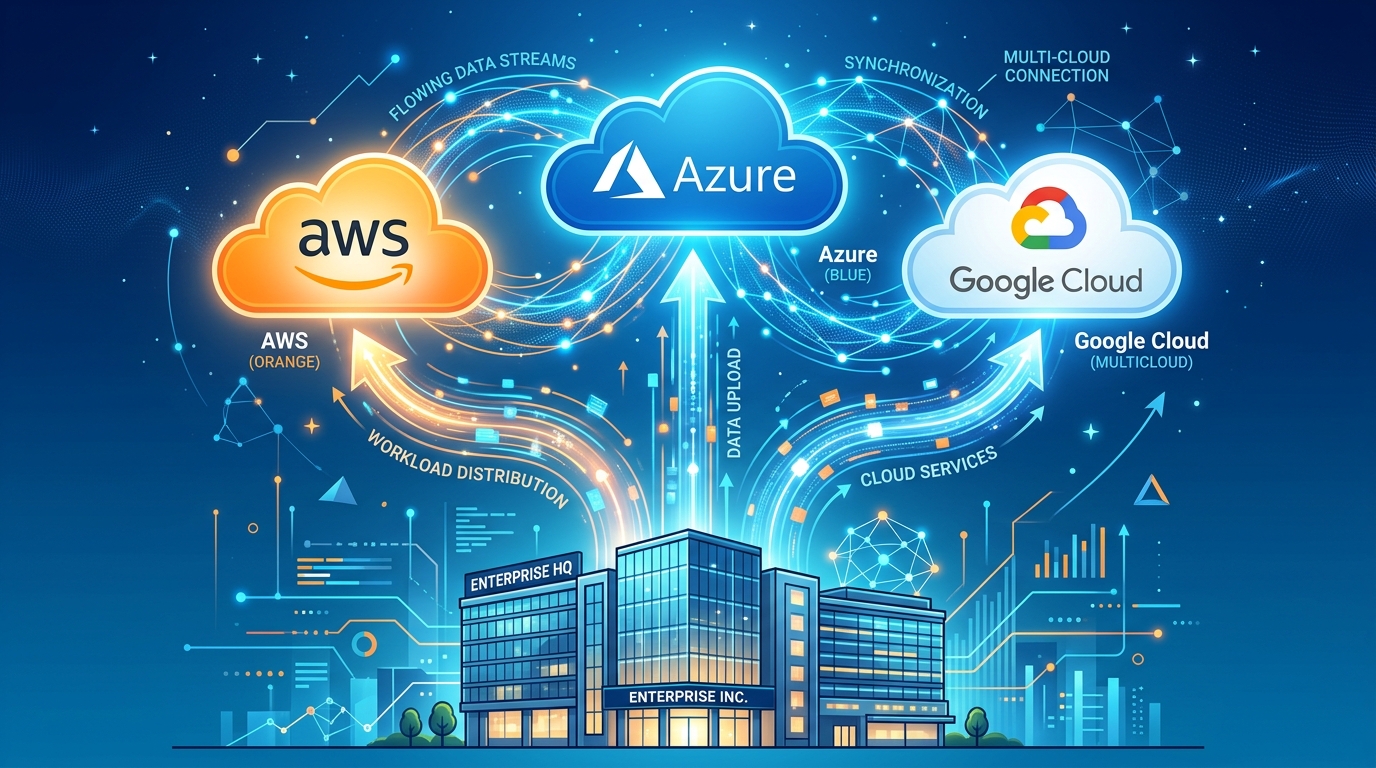
The multi-cloud strategy debate that dominated enterprise IT discussions for years has effectively been settled: multi-cloud is no longer optional for large organizations. It’s a practical necessity driven by vendor risk management, regulatory compliance, workload optimization, and the simple fact that no single cloud provider excels at everything. A 2025 survey by Flexera found that 89% of enterprises have adopted a multi-cloud strategy, with the average enterprise using 3.4 cloud providers. But “using multiple clouds” and “having a coherent multi-cloud strategy” are very different things, and most organizations are still struggling with the complexity, cost, and operational overhead of managing workloads across providers.
Why Multi-Cloud Became Mandatory
Vendor lock-in risk is the most cited motivation for multi-cloud adoption. Concentrating all workloads on a single cloud provider creates a dependency that affects negotiating leverage (the provider can raise prices knowing that migration is expensive), operational risk (an outage at that provider takes down everything), and strategic flexibility (the organization can’t easily adopt capabilities from other providers). Major cloud outages — including several high-profile AWS and Azure incidents that knocked out services for hours — have made the single-provider risk tangible for enterprise boards and CIOs.
Regulatory requirements are the second driver. Financial services regulations in the EU (DORA — Digital Operational Resilience Act) explicitly require that critical financial institutions avoid concentration risk in cloud providers. Healthcare organizations processing data in multiple countries need to use cloud regions that comply with each jurisdiction’s data residency laws — and no single provider has data centers in every required jurisdiction. Government agencies in many countries mandate that certain workloads run on specific clouds (US government workloads on GovCloud or Azure Government, Chinese government workloads on domestic providers).
Best-of-breed capability selection is the third motivation. Each cloud provider has distinctive strengths: AWS has the broadest service catalog and the deepest ecosystem; Azure has the strongest enterprise integration (Active Directory, Office 365, Dynamics 365); Google Cloud has the most advanced data analytics and AI/ML capabilities. Organizations that want the best available service for each workload naturally end up using multiple providers. A company might run its core business applications on Azure (for Active Directory integration), its data warehouse on Google BigQuery (for its unique serverless analytics architecture), and its startup-style microservices on AWS (for Lambda and the broadest selection of managed services).
Mergers and acquisitions create multi-cloud environments by default. When two companies merge, they bring their existing cloud environments with them. Consolidating onto a single provider is expensive, risky, and time-consuming — often taking years. In the meantime, the merged entity operates in a multi-cloud environment whether they planned to or not. Given the pace of M&A activity in technology, this “accidental multi-cloud” scenario is extremely common.
The Cost Complexity Problem
Multi-cloud cost management is the number one operational challenge, regularly cited by FinOps practitioners as more difficult than managing costs on a single provider. Each cloud provider has its own pricing model, its own discount structures (reserved instances vs. committed use discounts vs. savings plans), its own data transfer charges, and its own free tier limits. Comparing the cost of running the same workload across providers requires expertise in all three pricing models and an understanding of how architectural differences (different instance types, storage tiers, network topologies) affect total cost.
Data transfer costs — often called the “cloud tax” — are a particularly painful aspect of multi-cloud economics. Cross-cloud data transfer (moving data from AWS to Azure, or vice versa) incurs egress charges from the sending provider, typically $0.08-$0.12 per GB. For data-intensive workloads that need to share data across clouds, these transfer costs can exceed the compute and storage costs. This economic reality encourages data gravity — the tendency for workloads to cluster around the cloud where their data lives — which works against the flexibility that multi-cloud is supposed to provide.
Cloud cost management platforms (CloudHealth/VMware, Apptio/IBM, Spot by NetApp, and native tools like AWS Cost Explorer and Azure Cost Management) provide cross-cloud cost visibility, optimization recommendations, and governance policies. But the fundamental complexity remains: optimizing costs across multiple providers requires dedicated FinOps expertise that many organizations lack. A 2025 FinOps Foundation survey found that organizations estimate they waste 27% of their cloud spend on average, with multi-cloud environments showing higher waste percentages than single-cloud deployments due to the added complexity.
Abstraction Layers and Portability
The dream of multi-cloud is workload portability — the ability to move an application from one cloud to another with minimal effort, and to deploy the same application simultaneously across multiple clouds. The reality is that portability exists on a spectrum, and achieving true portability requires deliberate architectural choices that have real costs.
Kubernetes has become the de facto abstraction layer for multi-cloud compute. A containerized application running on Kubernetes can theoretically run on any Kubernetes cluster — whether it’s AWS EKS, Azure AKS, Google GKE, or an on-premises cluster. In practice, applications that use cloud-specific services (AWS RDS, Azure Cosmos DB, Google Cloud Spanner) are not portable because those services don’t exist on other clouds. Achieving portability means either avoiding cloud-specific services entirely (forgoing their advantages) or building abstraction layers that can swap underlying implementations.
Terraform (now OpenTofu, after HashiCorp’s license change) provides infrastructure-as-code portability across clouds. You can define infrastructure resources — virtual machines, networks, storage, databases — in Terraform configuration files and deploy them to any supported cloud provider. But Terraform portability is at the infrastructure level, not the application level: a Terraform configuration for AWS infrastructure won’t work on Azure without significant rewriting, because the resource types, properties, and behaviors are different. Cross-cloud Terraform requires maintaining parallel configurations for each provider.
Crossplane, a Kubernetes-native multi-cloud control plane, represents the next evolution of multi-cloud abstraction. Crossplane defines cloud resources as Kubernetes custom resources, enabling teams to provision and manage AWS, Azure, and Google Cloud resources using the same Kubernetes APIs they use for container orchestration. This unified API layer reduces the cognitive overhead of working across multiple providers, though it adds its own layer of complexity and requires Kubernetes expertise.
Multi-Cloud Networking
Connecting workloads running across multiple cloud providers is one of the most technically challenging aspects of multi-cloud architecture. Each cloud provider has its own virtual networking model (AWS VPC, Azure VNet, Google VPC), its own load balancing services, its own DNS management, and its own security group and firewall constructs. Creating a unified network that spans multiple clouds — where workloads on AWS can communicate with workloads on Azure as if they were on the same network — requires either direct interconnects between cloud providers or overlay networking technology.
Cloud interconnect services provide dedicated, high-bandwidth, low-latency connections between cloud providers. Megaport, Equinix Cloud Exchange, PacketFabric, and other network-as-a-service providers offer cross-cloud connectivity through their global networks. These services typically provide 1-100 Gbps connections with single-digit millisecond latency between providers, enabling the real-time data synchronization and low-latency communication that multi-cloud architectures require.
Service mesh technology — particularly Istio and Linkerd — provides application-layer networking that abstracts away the underlying cloud network topology. A service mesh running across multiple clouds handles service discovery (finding where each microservice is running regardless of which cloud it’s on), load balancing (distributing requests across service instances on multiple clouds), security (mutual TLS encryption between all services), and observability (distributed tracing across cloud boundaries). Implementing a cross-cloud service mesh is operationally complex but provides the kind of seamless inter-cloud communication that multi-cloud architectures require.
Multi-Cloud Security
Security in a multi-cloud environment is multiplicatively more complex than single-cloud security. Each provider has its own identity and access management (IAM) system, its own security monitoring tools, its own compliance frameworks, and its own security best practices. A security team that’s expert in AWS security isn’t automatically competent in Azure security — the concepts are similar but the implementations, configurations, and gotchas are different.
Cloud Security Posture Management (CSPM) tools — Prisma Cloud (Palo Alto Networks), Wiz, Orca, and Lacework — provide unified security visibility across multiple cloud providers, scanning for misconfigurations, compliance violations, and vulnerabilities in a single dashboard. These tools have become essential for multi-cloud security teams because manually auditing security configurations across three or more cloud providers is impractical. The CSPM market is projected to reach $8 billion by 2027, driven almost entirely by multi-cloud security needs.
Identity federation across clouds is a critical requirement. Rather than managing separate user identities on each cloud provider, organizations use a centralized identity provider (Azure Active Directory, Okta, Ping Identity) that federates authentication across all clouds. Single sign-on (SSO) enables users to access resources on any cloud with a single set of credentials, while role-based access control (RBAC) ensures consistent authorization policies regardless of where resources are deployed.
The zero-trust security model is particularly relevant to multi-cloud environments because the traditional network perimeter (a clearly defined boundary between “inside” and “outside” the corporate network) doesn’t exist when workloads span multiple clouds, on-premises data centers, and edge locations. Zero trust treats every access request as potentially hostile regardless of network location, requiring authentication and authorization for every interaction. This model is naturally multi-cloud because it doesn’t depend on the network architecture of any single provider.
When Multi-Cloud Doesn’t Make Sense
Despite its prevalence, multi-cloud isn’t the right strategy for every organization. Small and mid-sized companies with limited IT teams often find that the operational overhead of managing multiple clouds exceeds the benefits. The complexity of multi-cloud — different APIs, different management consoles, different billing models, different security tools — requires specialized expertise that smaller teams don’t have.
For organizations that don’t have regulatory requirements mandating multi-cloud, that don’t have vendor lock-in concerns (because their workloads are relatively portable), and that don’t have best-of-breed requirements that span providers, a well-managed single-cloud strategy with robust disaster recovery may be simpler, cheaper, and more effective. The cloud industry often assumes multi-cloud is inherently desirable, but the practical experience of many organizations is that the complexity costs outweigh the benefits unless the specific drivers (regulation, risk management, M&A, capability selection) are present.
The most pragmatic approach for most organizations is “cloud-smart” rather than dogmatically multi-cloud: choose the best cloud provider for your primary workloads, use additional providers only when there’s a specific, justified reason, and ensure that your critical applications have disaster recovery capabilities that could be deployed to an alternative provider if needed. This approach captures the risk mitigation benefits of multi-cloud without the full operational complexity of running production workloads on three or more providers simultaneously.
Related articles: Fintech Super Apps Dominate Emerging Mar | Neuromorphic Computing: Brain-Inspired C | 3D Bioprinting in 2026: From Lab Curiosi