
Robotics Hits an Inflection Point: AI-Powered Humanoid Robots Enter the Workplace
Robotics companies delivered a record 580,000 industrial robots worldwide in 2025, up 14% from the previous year, while a new category of general-purpose humanoid robots moved from laboratory prototypes to real-world pilot deployments. The robotics industry is hitting an inflection point where AI capabilities finally match the mechanical sophistication that engineers have been building for decades — and the results are robots that can learn tasks rather than just execute pre-programmed routines.
Industrial Robotics Surge
Traditional industrial robots — the articulated arms that weld, paint, pick-and-place, and assemble in factories — continued their steady growth driven by manufacturing automation in China (52% of global installations), automotive electrification requiring new assembly lines, and the semiconductor industry expanding fabrication capacity worldwide.
The notable shift within industrial robotics is the rise of collaborative robots (“cobots”) that work alongside humans rather than in caged-off areas. Cobots now represent 12% of all industrial robot installations, up from 5% three years ago. Universal Robots, FANUC, and ABB lead the market with models priced under $50,000 that small and mid-size manufacturers can deploy without dedicated robotics engineers — a democratization of automation that was previously restricted to large enterprises with specialized staff.
Humanoid Robots Enter the Workplace
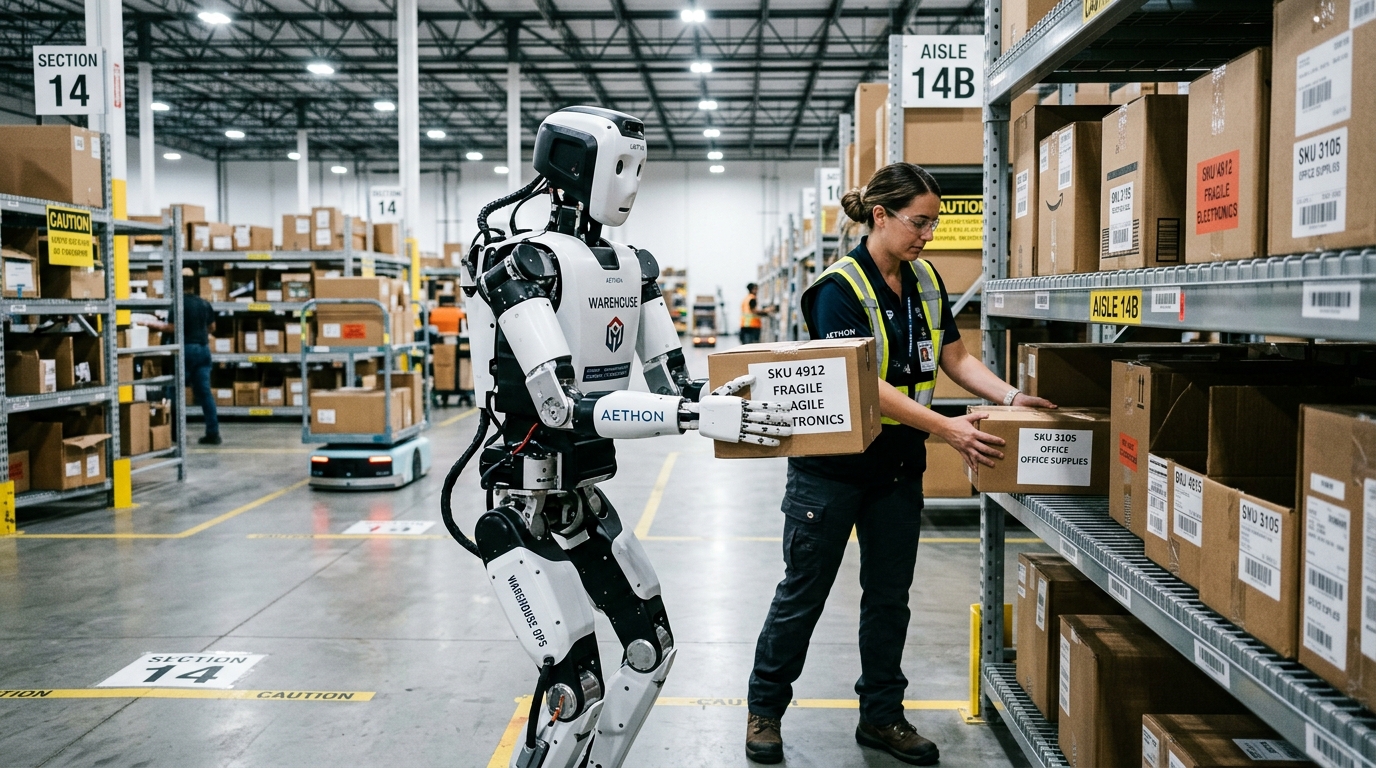
The most anticipated development is the deployment of humanoid robots in real work environments. Figure AI’s Figure 02 is now operating in BMW’s Spartanburg manufacturing facility, performing tasks including parts sorting, tote carrying, and quality inspection alongside human workers. Tesla’s Optimus Gen 3 is being tested in Tesla’s own factories and two external pilot sites. 1X Technologies’ NEO Beta is deployed in warehouse navigation and package handling at a logistics company in Norway.
These robots aren’t doing complex assembly — they’re handling repetitive physical tasks that are difficult to automate with traditional fixed robotics because they require mobility, object recognition, and the ability to adapt to variable environments. A humanoid robot can walk between workstations, pick up irregularly shaped objects from bins, and navigate around obstacles — capabilities that fixed robotic arms lack by design.
AI as the Missing Piece
The enabling technology behind this generation of robots isn’t mechanical — it’s AI. Foundation models trained on millions of hours of video data can understand physical environments, recognize objects, and plan movement sequences in ways that previous rule-based programming could not. Figure 02 uses a multimodal AI model that processes camera feeds to understand its surroundings, plan grasping strategies for novel objects, and communicate with human coworkers through natural language.
Reinforcement learning trained in simulation allows robots to acquire physical skills — walking, balancing, manipulating objects — far faster than real-world trial-and-error. A robot can practice picking up thousands of different objects in a digital simulation overnight, then transfer those skills to its physical body the next day. This sim-to-real pipeline is accelerating the pace at which humanoid robots gain practical capabilities.
Timeline to Scale
Industry leaders project that humanoid robots will reach mass production (100,000+ units annually) by 2030, with costs dropping from the current $50,000-$100,000 range to $20,000-$30,000 — comparable to the annual cost of a minimum-wage worker. The economic implications are profound and contentious. Proponents argue that robots will fill the 10 million unfilled manufacturing and warehouse jobs that employers can’t recruit for. Critics warn of large-scale job displacement in categories already vulnerable to automation. Both outcomes are likely simultaneously true in different sectors and geographies.
How This Technology Works
The underlying mechanisms of this technology have evolved significantly. Modern implementations leverage advanced algorithms and machine learning patterns to deliver results at scale.
Key Benefits and Use Cases
- Enterprise-level scalability and performance
- Real-world applications across multiple industries
- Cost-effectiveness compared to traditional approaches
- Future-proof architecture for emerging needs
Challenges and Limitations
While promising, current implementations face several hurdles including integration complexity, resource requirements, and the need for specialized expertise. Organizations must carefully evaluate their readiness before implementation.
What’s Next?
The trajectory suggests continued innovation and adoption. Industry experts predict significant advancements in the coming years as technology matures and becomes more accessible to organizations of all sizes.
Conclusion
Robotics Hits an Inflection Point: AI-Powered Humanoid Robots Enter the Workplace represents an important milestone in technological evolution. As the landscape continues to shift, staying informed about these developments will be crucial for businesses and professionals alike.