E-Waste Recycling Technology Breakthroughs: Making Circular Electronics a Reality in 2026
Electronic waste is the fastest-growing waste stream on the planet, reaching 62 million metric tons in 2025 — a figure that grows 3-5% annually as device lifespans shorten and global electronics consumption increases. Less than 20% of e-waste is formally recycled; the rest ends up in landfills, is informally processed under hazardous conditions in developing countries, or is stockpiled in storage. This is both an environmental catastrophe (e-waste contains toxic materials including lead, mercury, cadmium, and flame retardants that contaminate soil and groundwater) and an economic absurdity (e-waste contains approximately $62 billion worth of recoverable precious metals, rare earth elements, and other valuable materials annually). New recycling technologies and regulatory frameworks are finally creating momentum toward solving both problems.
What’s in E-Waste and Why It Matters
A single smartphone contains over 30 different elements, including gold, silver, platinum, palladium, copper, cobalt, lithium, neodymium, and numerous other materials mined at significant environmental and human cost. A ton of circuit boards contains 40-800 times more gold than a ton of gold ore. The critical minerals in e-waste — cobalt, lithium, rare earth elements — are the same materials driving geopolitical competition for battery supply chains and semiconductor manufacturing. Recovering these materials from e-waste is not just environmentally responsible; it’s strategically valuable for countries seeking to reduce dependency on mining and foreign mineral imports.
The toxic component is equally important. A single CRT monitor contains 2-4 kg of lead. Older flat-panel displays contain mercury. Printed circuit boards are coated in brominated flame retardants (BFRs) that are persistent organic pollutants. Lithium-ion batteries can catch fire if damaged during improper recycling. When e-waste enters landfills, these materials leach into soil and groundwater over decades. When e-waste is informally processed — as happens in large-scale operations in Ghana, Nigeria, India, Pakistan, and China — workers burn circuit boards in open fires to recover copper, exposing themselves and surrounding communities to toxic fumes containing dioxins, furans, and heavy metals.
The human cost of informal e-waste processing is well-documented. Studies of communities near informal e-waste processing sites consistently find elevated levels of lead and cadmium in children’s blood, increased rates of respiratory disease, and contaminated local food supplies. The Agbogbloshie site in Accra, Ghana — one of the world’s largest informal e-waste processing operations — has been found to have soil lead levels hundreds of times above safe limits. The Basel Convention (an international treaty controlling international transport of hazardous waste) was designed to prevent wealthy countries from exporting e-waste to developing countries, but enforcement gaps and legal loopholes (particularly the classification of used electronics as “secondhand goods” rather than waste) allow significant volumes of e-waste to continue flowing from rich to poor countries.
Advanced Recycling Technologies
The e-waste recycling industry is being transformed by technologies that dramatically improve material recovery rates, reduce the environmental impact of recycling processes, and make it economically viable to recover materials that were previously too expensive to extract.
Hydrometallurgy — using chemical solutions (acids, bases, and selective solvents) to dissolve and selectively precipitate metals from shredded e-waste — is replacing pyrometallurgy (smelting) as the primary metal recovery technique. Hydrometallurgical processes operate at lower temperatures, consume less energy, produce fewer emissions, and can recover a wider range of metals with higher purity than smelting. Companies like Li-Cycle (for lithium-ion batteries) and Mint Innovation (for precious metals) use hydrometallurgical processes that recover 95%+ of target metals from e-waste, compared to 60-80% for traditional pyrometallurgical approaches.
Biometallurgy — using bacteria, fungi, or other organisms to extract metals from e-waste — is an emerging approach with potentially lower environmental impact than chemical processes. Certain bacteria (Acidithiobacillus ferrooxidans, Chromobacterium violaceum) naturally produce acids or cyanide compounds that dissolve metals from ore — a process long used in mining (bioleaching) that is being adapted for e-waste. Researchers at the University of Edinburgh have demonstrated bacterial recovery of gold from printed circuit boards with recovery rates exceeding 90%. The advantages of biometallurgy include lower energy consumption, less toxic chemicals, and the potential for highly selective metal recovery. The disadvantages are slower processing speed (days rather than hours) and sensitivity to process conditions.
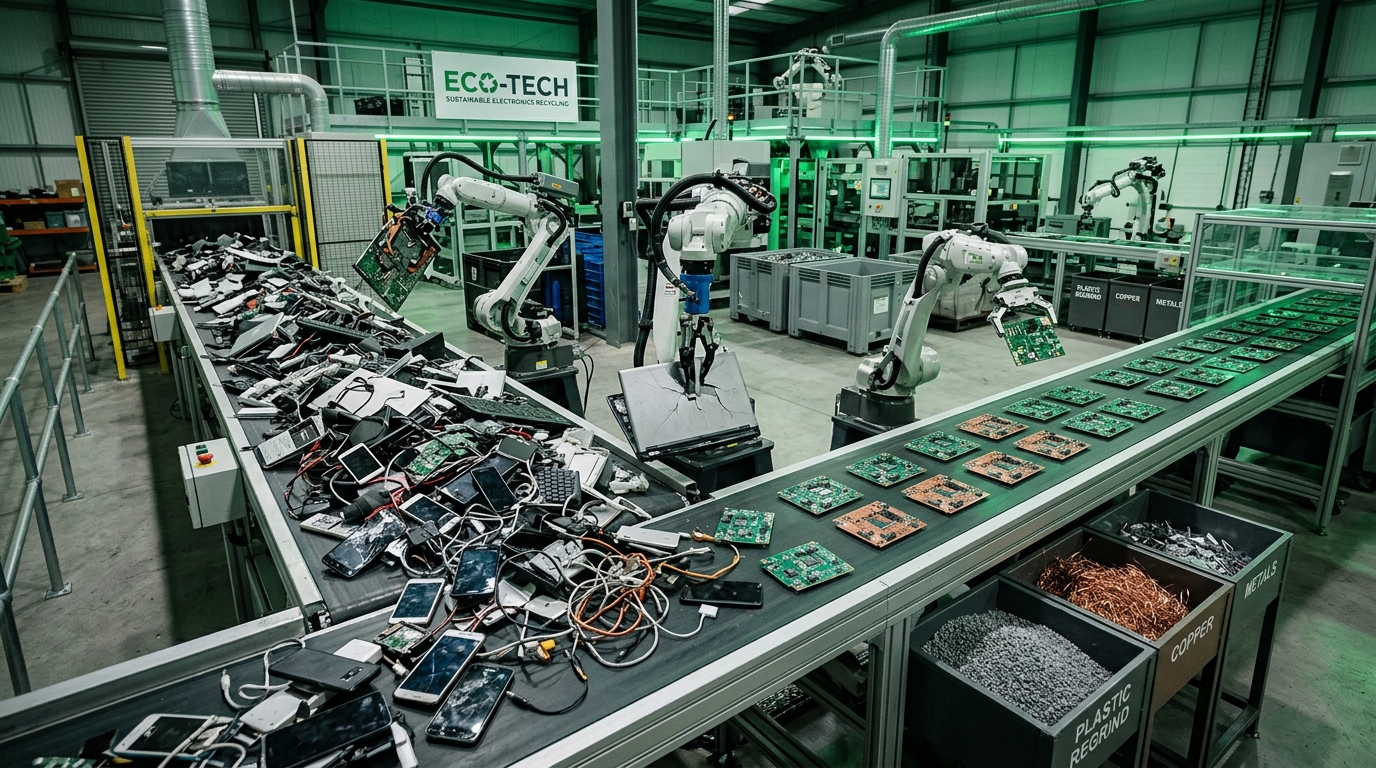
Robotic disassembly is addressing one of e-waste recycling’s most persistent challenges: the manual labor required to disassemble diverse, complex electronic devices before material recovery. Apple’s Daisy robot can disassemble 1.2 million iPhones per year, recovering 14 materials including rare earth elements that manual disassembly cannot economically extract. Li-Cycle and other battery recyclers use automated mechanical processes (shredding, magnetic separation, gravitational separation, float-sink density separation) that can process unsorted batteries without manual pre-sorting, dramatically increasing throughput.
AI-powered sorting is improving the front end of recycling operations. Computer vision systems trained on e-waste imagery can identify device types, components, and materials on a conveyor belt, enabling automated sorting that directs different materials to appropriate processing streams. AMP Robotics, ZenRobotics, and other AI recycling companies have developed systems with 95%+ sorting accuracy that operate at speeds thousands of times faster than manual sorting. These systems are being adapted specifically for e-waste, which presents unique challenges due to the diversity of device types, small component sizes, and similarity in appearance between materials with very different recycling requirements.
Battery Recycling: The Most Urgent Challenge
Lithium-ion battery recycling is the most commercially significant and environmentally urgent segment of e-waste recycling. The volume of lithium-ion batteries reaching end-of-life is projected to exceed 11 million tons per year by 2030, driven by the electrification of transportation (each electric vehicle contains 300-1,000 kg of batteries) and the shorter replacement cycles of consumer electronics. Without effective recycling, this battery waste represents both an environmental hazard (batteries contain cobalt, nickel, and lithium that are toxic in landfills and fire hazards if damaged) and a missed economic opportunity (the lithium, cobalt, nickel, and copper in spent batteries are worth an estimated $30 billion annually by 2030).
Redwood Materials, founded by former Tesla CTO JB Straubel, is the largest lithium-ion battery recycler in the US, processing battery materials from Panasonic, Amazon, and other partners. Their hydrometallurgical process recovers 95%+ of lithium, cobalt, nickel, and copper from spent batteries and anode/cathode manufacturing scrap. Critically, Redwood Materials doesn’t just recover raw materials — they produce battery-grade cathode and anode components that can be directly used in new battery manufacturing, creating a closed-loop supply chain that reduces dependence on mining.
Li-Cycle, a publicly traded Canadian company, operates battery recycling facilities in North America and Europe using a two-step process: mechanical processing converts batteries into “black mass” (a mixed powder containing the valuable metals), and hydrometallurgical processing separates and refines the individual metals. Li-Cycle’s process handles all lithium-ion battery chemistries without manual pre-sorting, which is essential for scaling recycling beyond specific battery types.
The EU’s Battery Regulation (effective 2025) establishes mandatory recycled content requirements for new batteries: 16% recycled cobalt, 6% recycled lithium, and 6% recycled nickel by 2031, rising to 26% cobalt, 12% lithium, and 15% nickel by 2036. These requirements create guaranteed demand for recycled battery materials and incentivize investment in recycling infrastructure. The US Inflation Reduction Act provides tax credits for domestic battery material production (including from recycling), further incentivizing the development of battery recycling capacity.
Right to Repair and Lifespan Extension
The most sustainable approach to e-waste is preventing it — extending device lifespans so that fewer devices are discarded. The right-to-repair movement, which has gained significant legislative and regulatory momentum, aims to give consumers and independent repair shops the ability to fix their own devices rather than being forced to replace them. Laws requiring manufacturers to provide spare parts, repair manuals, and diagnostic tools have been enacted in the EU, several US states (California, New York, Minnesota, Oregon, Colorado), and Australia.
The EU’s Ecodesign Regulation sets repairability and recyclability requirements for electronic devices sold in Europe: smartphones must have user-replaceable batteries (phased in by 2027), spare parts must be available for at least 7 years after a device model is discontinued, and products must include a repairability score that consumers can evaluate before purchase. France’s repairability index, implemented since 2021, has already demonstrated that consumer-visible repairability ratings influence purchasing decisions and incentivize manufacturers to design more repairable products.
Apple, long criticized for restrictive repair policies, has made notable concessions: the Self Service Repair program provides genuine Apple parts and repair tools to consumers, and recent iPhone models have been scored highly on repairability indices (the iPhone 16 received a 7.4/10 on iFixit’s repairability scale, up from 4/10 for earlier models). Samsung’s Galaxy S24 earned an 8/10 repairability score. These improvements reflect both regulatory pressure and a recognition that repairability is becoming a competitive differentiator for environmentally conscious consumers.
Refurbishment and second-life markets extend device lifespans further. The refurbished electronics market is projected to reach $200 billion by 2028. Amazon Renewed, Apple Certified Refurbished, Back Market, and Gazelle provide quality-assured refurbished devices at 20-50% discounts. Companies like Assurant and Likewize provide large-scale device refurbishment services for carriers and manufacturers. Each refurbished device that displaces a new purchase prevents the mining, manufacturing, and eventual disposal of a new device — a net environmental benefit that recycling alone cannot match.
The Circular Economy Vision
The long-term vision for e-waste is a circular economy where materials flow in closed loops: devices are designed for disassembly and recycling, used materials are recovered at high rates, and recovered materials feed back into manufacturing. This vision requires coordination across the entire value chain — design (products designed for easy disassembly and material recovery), collection (convenient infrastructure for consumers to return used devices), recycling (technologies that recover all valuable materials), and manufacturing (processes that accept recycled materials).
Extended Producer Responsibility (EPR) laws — which make manufacturers financially responsible for the end-of-life management of their products — provide an economic mechanism to drive circular design. When manufacturers bear the cost of recycling, they have an economic incentive to design products that are cheaper to recycle (fewer material types, easier disassembly, material labeling). EPR for electronics exists in the EU and is being adopted in an increasing number of US states and other countries.
The gap between the circular economy vision and current reality remains large. Recovery rates for precious metals are 95%+ from concentrated sources (like smartphone circuit boards) but much lower from diffuse applications. Rare earth elements, despite their strategic importance, are recycled at rates below 1% because they’re used in small quantities in complex assemblies. Plastic recovery from e-waste is particularly challenging because electronics use dozens of different plastic types, often combined with flame retardants and other additives that complicate recycling. Achieving a genuinely circular electronics economy will require sustained investment in recycling technology, continued regulatory pressure on manufacturers, and consumer behavior change around device longevity and responsible disposal — a multi-decade transition that is underway but far from complete.