Windows 12 Release Date Confirmed: AI-Native Design, Modular Architecture, DirectX 13
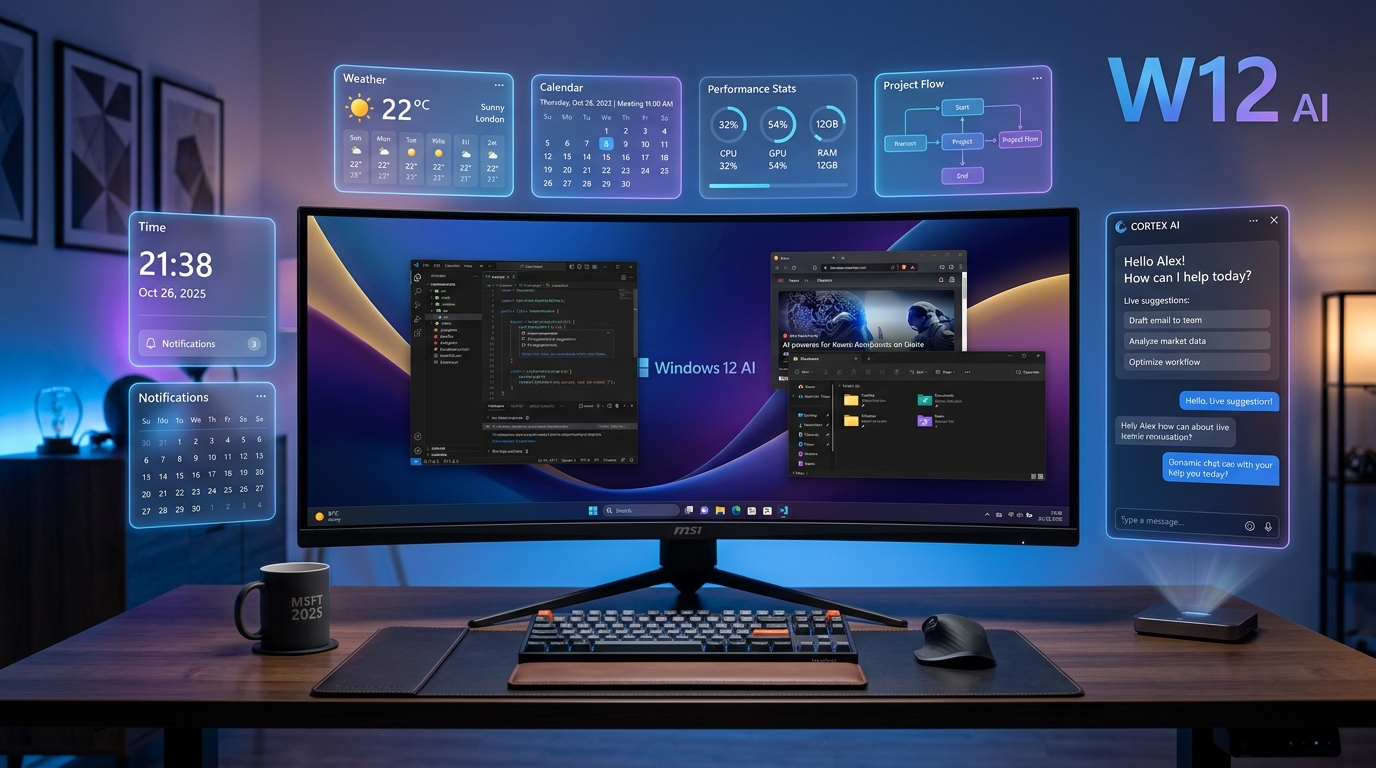
Microsoft confirmed that Windows 12 will launch in October 2026, introducing the most significant architectural changes to the operating system since the Windows NT kernel transition in the 1990s. The new OS is built around what Microsoft calls a “Copilot-native” design philosophy, where AI assistance is woven into every aspect of the user experience — from file management and settings to creative tools and system diagnostics.
AI-First Interface Design
Windows 12’s most visible change is the new “Copilot Shell” — a persistent AI interface that replaces the traditional Start Menu as the primary way users interact with their PC. Instead of navigating through nested menus and settings panels, users can type or speak natural language requests: “Find that PDF I was editing last Tuesday,” “Make my display easier on my eyes for nighttime use,” “Uninstall apps I haven’t used in 6 months,” or “Why is my laptop running slowly?”
Copilot Shell uses a local AI model running on the device’s NPU (neural processing unit) for basic queries, with cloud-based Copilot handling complex requests. Microsoft guarantees that local-only queries never leave the device — a privacy boundary that addresses concerns about AI assistants sending personal data to cloud servers. On devices without dedicated NPUs, a smaller CPU-based model handles basic functions with cloud fallback for advanced features.
Modular Architecture
Under the hood, Windows 12 adopts a modular “CorePC” architecture that separates the operating system into discrete, independently updatable components. The kernel, graphics stack, networking stack, and application platform can each be updated without requiring a full OS restart. This eliminates the “Patch Tuesday reboot cycle” that has been a Windows staple for decades — most security and feature updates will apply silently in the background.
Modular design also means Windows 12 can be configured differently for different device types. A gaming PC gets the full desktop experience with DirectX 13 support. A lightweight laptop gets a streamlined configuration optimized for battery life. An ARM-based tablet gets a touch-optimized interface that feels closer to iPadOS. All running the same underlying Windows 12 kernel but with different component combinations.
Hardware Requirements and Compatibility
Minimum requirements include a 64-bit processor with at least 4 cores, 8GB RAM, 128GB storage, TPM 2.0, and Secure Boot. Recommended specs include 16GB RAM and a dedicated NPU for full Copilot Shell functionality. Microsoft confirmed that PCs meeting Windows 11 requirements will receive Windows 12 as a free upgrade, addressing the compatibility controversy that locked millions of older PCs out of Windows 11.
DirectX 13 introduces mesh shading improvements, hardware-accelerated neural rendering (using AI to generate game frames), and a unified ray tracing pipeline that simplifies development for studios targeting both PC and Xbox. Gaming performance should see a 5-15% improvement over Windows 11 at the driver level, independent of hardware upgrades.
Enterprise and Developer Focus
For IT administrators, Windows 12 introduces an AI-powered management console that predicts device failures before they happen, automatically remediates common issues, and reduces help desk tickets by an estimated 30%. Dev Drive 2.0 — a specialized filesystem for developer workloads — improves build times by 25% over the already-improved Dev Drive in Windows 11. Native support for Linux containers without WSL2 means developers can run Linux workloads alongside Windows apps with lower overhead and better integration.
How This Technology Works
The underlying mechanisms of this technology have evolved significantly. Modern implementations leverage advanced algorithms and machine learning patterns to deliver results at scale.
Key Benefits and Use Cases
- Enterprise-level scalability and performance
- Real-world applications across multiple industries
- Cost-effectiveness compared to traditional approaches
- Future-proof architecture for emerging needs
Challenges and Limitations
While promising, current implementations face several hurdles including integration complexity, resource requirements, and the need for specialized expertise. Organizations must carefully evaluate their readiness before implementation.
What’s Next?
The trajectory suggests continued innovation and adoption. Industry experts predict significant advancements in the coming years as technology matures and becomes more accessible to organizations of all sizes.
Conclusion
Windows 12 Release Date Confirmed: AI-Native Design, Modular Architecture, DirectX 13 represents an important milestone in technological evolution. As the landscape continues to shift, staying informed about these developments will be crucial for businesses and professionals alike.