Edge Computing in 2026: How Processing at the Source Is Transforming IoT and AI Deployment
Edge computing — processing data close to where it’s generated rather than sending it to centralized cloud data centers — has shifted from a niche concept to a critical infrastructure layer. The explosion of IoT devices (projected to exceed 30 billion connected devices in 2026), the latency demands of AI inference, the bandwidth constraints of video analytics, and the data sovereignty requirements of global regulations are all driving compute capacity out of the cloud and into factories, retail stores, cell towers, vehicles, and edge data centers positioned within miles of end users. The edge computing market is projected to reach $90 billion in 2026, and the growth rate shows no sign of slowing.
Why the Cloud Isn’t Enough
Cloud computing hasn’t failed — it’s thriving. But certain workloads have requirements that centralized cloud architecture fundamentally cannot meet. Latency is the most common driver: a self-driving car generating 4 TB of sensor data per hour cannot send that data to a cloud data center 500 miles away, wait for processing, and receive a decision. The round-trip latency of 50-100 milliseconds that’s typical for cloud requests is fine for web browsing but potentially fatal for autonomous vehicle navigation. Similarly, a manufacturing robot performing quality inspection at 100 items per minute needs sub-10ms inference responses that only local processing can provide.
Bandwidth is the second driver. Video surveillance systems, industrial sensor networks, and connected vehicles generate enormous volumes of data — far more than it’s practical or economical to transmit to the cloud. A medium-sized factory with 500 IoT sensors generating data every second produces approximately 43 GB of raw data per day. A fleet of 100 delivery vehicles with cameras generates terabytes daily. Transmitting all of this to the cloud for processing is prohibitively expensive in bandwidth costs and physically impossible in areas with limited connectivity.
Data sovereignty and privacy regulations provide the third driver. GDPR in the EU, PIPL in China, LGPD in Brazil, and data localization laws in India, Russia, and dozens of other countries require that certain categories of data be processed within national or regional borders. For global companies operating in multiple jurisdictions simultaneously, edge computing provides a way to process data locally in compliance with each jurisdiction’s requirements without building separate centralized cloud infrastructure in every country.
Reliability is the fourth factor. Applications that must continue operating during cloud outages or network disconnections — factory automation, healthcare monitoring, retail point-of-sale systems — need local compute capability that doesn’t depend on an internet connection. Edge computing provides this resilience by enabling critical processing to continue autonomously, synchronizing with the cloud when connectivity is available but not depending on it.
The Edge Architecture Stack
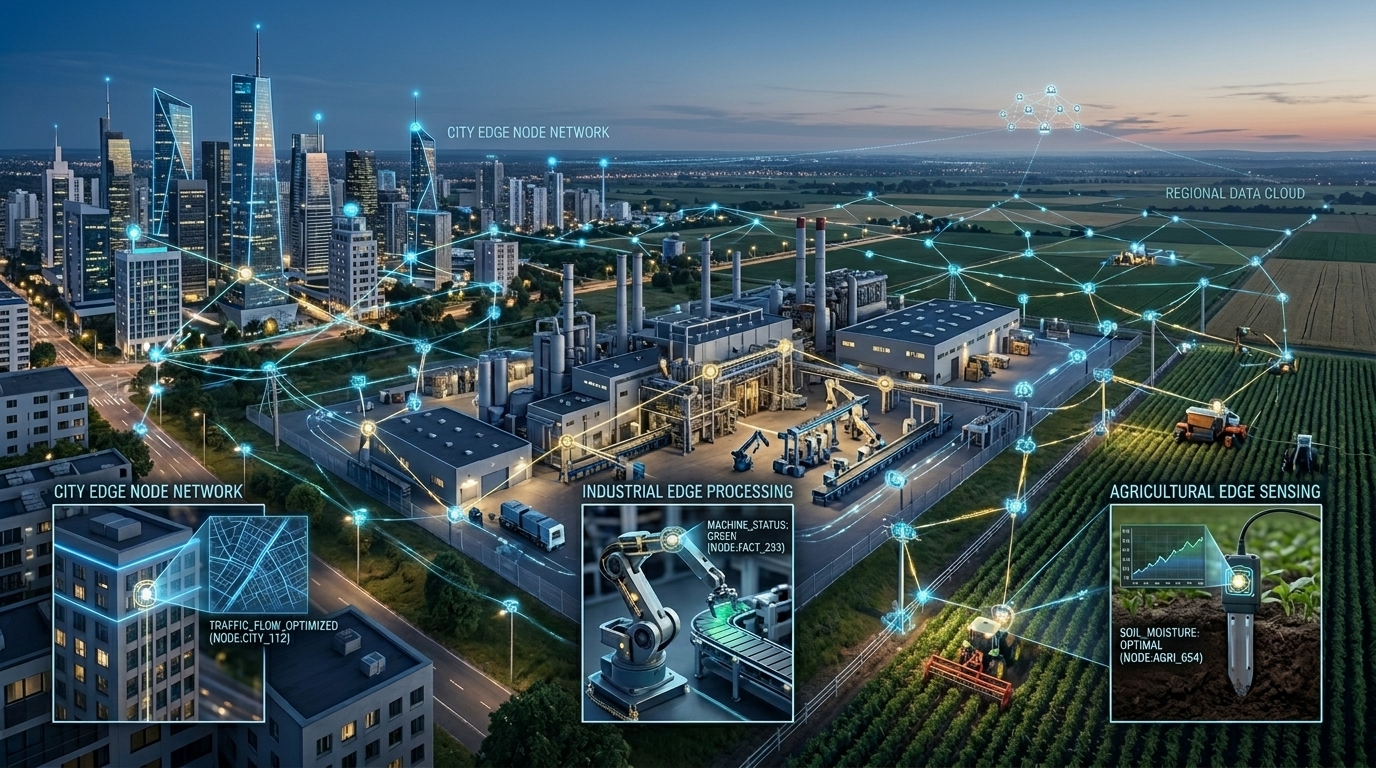
Edge computing isn’t a single technology but a spectrum of computing locations between the device and the cloud. The “far edge” or “device edge” includes processing directly on IoT devices, sensors, and embedded systems — using microcontrollers and AI accelerator chips to run inference models locally. The “near edge” includes on-premises servers, gateway devices, and micro data centers deployed at customer locations (factories, stores, hospitals). The “network edge” includes compute infrastructure deployed at cell towers, internet exchange points, and regional colocation facilities operated by telecom providers and CDN companies.
At the device edge, the critical technology is edge AI inference — running machine learning models directly on embedded hardware. NVIDIA’s Jetson platform (from the entry-level Orin Nano to the high-performance AGX Orin) provides GPU-accelerated inference for applications ranging from security cameras to agricultural drones. Google’s Coral TPU accelerator provides efficient inference for TensorFlow Lite models in compact form factors. Qualcomm, Intel, and ARM-based processors with neural processing units (NPUs) are also capable of running models that would have required cloud processing just two years ago.
At the near edge, organizations deploy edge servers or micro data centers running lightweight Kubernetes distributions (K3s, MicroK8s, AWS EKS Anywhere) that provide the same container orchestration capabilities as cloud Kubernetes but optimized for constrained edge environments. These systems run application workloads, aggregate data from device-edge sensors, perform local AI inference and analytics, and selectively transmit processed results to the cloud. Management platforms like Azure Arc, AWS Outposts, and Google Distributed Cloud extend cloud management capabilities to these on-premises edge deployments.
At the network edge, telecom companies are deploying Multi-access Edge Computing (MEC) infrastructure at 5G cell tower sites, providing ultra-low-latency compute accessible to any device connected to the mobile network. AWS Wavelength, Azure Edge Zones, and Google Distributed Cloud Connected embed cloud computing at telecom provider locations, enabling applications to access cloud services with single-digit millisecond latency over 5G. This network edge layer is particularly valuable for mobile AR/VR, connected vehicle applications, and multiplayer gaming where latency is the primary constraint.
Edge AI: The Killer Application
AI inference at the edge has emerged as the primary driver of edge computing investment. The economics are compelling: running a large language model or computer vision model in the cloud costs money per inference ($0.001-$0.01 per inference for typical models). For applications that make thousands or millions of inferences per day — a factory quality inspection system, a fleet of autonomous vehicles, a retail store’s shelf monitoring system — the cost of cloud inference is prohibitive and the latency is unacceptable. Processing these inferences locally on edge hardware eliminates both the per-query cloud cost and the network latency.
Computer vision is the most mature edge AI application domain. Security cameras with built-in AI processors can identify objects, detect anomalies, and recognize faces without sending video to the cloud — addressing both latency requirements and privacy concerns (video never leaves the premises). Retail chains use edge computer vision for shelf inventory monitoring, customer traffic analysis, and self-checkout theft prevention. Manufacturing plants use edge vision systems for real-time quality inspection at production line speeds.
Generative AI at the edge is an emerging frontier. Running small language models (under 7 billion parameters) on edge devices enables AI-powered customer service kiosks, voice assistants in vehicles, and smart home devices that process requests locally without cloud connectivity. Apple Intelligence, Qualcomm’s on-device AI, and Samsung’s Galaxy AI all demonstrate the viability of running capable AI models on consumer devices. Industrial applications of edge generative AI include automated report generation from sensor data, natural language interfaces for industrial controls, and predictive maintenance analysis processed locally on factory servers.
Connectivity: 5G and Beyond
5G networks are the enabling connectivity layer for many edge computing use cases. The key 5G capabilities for edge computing are: ultra-reliable low-latency communication (URLLC), which provides sub-1ms radio latency for critical applications; massive machine-type communication (mMTC), which supports up to 1 million connected devices per square kilometer; and network slicing, which creates dedicated virtual network segments with guaranteed performance characteristics for specific applications.
Private 5G networks — dedicated 5G infrastructure deployed within a factory, warehouse, or campus — are growing rapidly as an alternative to Wi-Fi for industrial IoT. Companies including BMW, Bosch, Siemens, and John Deere have deployed private 5G networks in manufacturing facilities, providing the reliable, low-latency wireless connectivity needed for autonomous mobile robots, real-time quality inspection, and digital twin synchronization. The CBRS spectrum band in the US (3.5 GHz) enables private 5G deployment without the need for licensed spectrum from a telecom carrier.
Satellite connectivity — particularly from Starlink’s rapidly growing constellation — is extending edge computing to locations without terrestrial connectivity. Oil platforms, mining operations, agricultural installations, and maritime vessels can now deploy edge computing systems connected to the cloud via satellite, with latencies of 20-40ms that are sufficient for most data synchronization and management tasks even if not for real-time interactive applications.
The Management Challenge
The operational complexity of edge computing is its biggest adoption barrier. Managing a fleet of edge devices deployed across hundreds or thousands of locations — each with its own hardware configuration, software stack, network conditions, and physical environment — is orders of magnitude more complex than managing cloud infrastructure in a handful of well-controlled data centers.
Software updates must be carefully staged and rolled back if problems occur, because a failed update to a factory edge server can halt production. Security patches must reach every edge device even when connectivity is intermittent. Hardware failures at remote locations require either on-site maintenance or sufficient redundancy to survive until a technician arrives. Monitoring must work across heterogeneous hardware and network conditions, detecting problems in real-time across a vastly distributed infrastructure.
GitOps and declarative configuration management are emerging as the operational frameworks for edge fleet management. Operators define the desired state of each edge location (what software should be running, what configuration should be applied) in version-controlled repositories, and automated systems continuously reconcile the actual state of each device with the desired state, applying updates and recovering from drift without manual intervention. Tools like Flux, ArgoCD, and platform-specific solutions from edge computing vendors provide this capability.
The convergence of edge computing and AI is creating self-managing edge infrastructure that can detect anomalies in its own operation, optimize resource allocation based on workload patterns, and predict hardware failures before they cause outages. This AI-for-operations approach is essential at edge scale because human operators cannot manually monitor thousands of distributed edge locations with the same attention they give to a few cloud data centers.
The Market Landscape
Every major cloud provider and several specialist companies are competing for the edge computing market. AWS offers a comprehensive edge stack: IoT Greengrass for device-edge AI, Outposts for on-premises cloud hardware, Wavelength for 5G edge computing, and Local Zones for regional low-latency compute. Microsoft Azure provides IoT Edge, Azure Stack HCI, Azure Arc, and Azure Edge Zones. Google offers Distributed Cloud for on-premises and edge deployment.
Specialist edge computing companies are carving out niches. Fastly and Cloudflare provide edge compute at CDN locations worldwide. ZEDEDA and Scale Computing focus on enterprise edge infrastructure management. Vapor IO deploys micro data centers at the base of cell towers. ClearBlade provides an edge-native IoT platform. The edge computing market is still early enough that no dominant architecture or platform has emerged — the equivalent of “AWS for the edge” doesn’t yet exist, and the next few years will determine whether cloud providers extend their dominance or specialist edge platforms establish an independent market.
The long-term trajectory of edge computing is clear: compute will be everywhere — in the cloud, at the edge, on the device — and applications will dynamically distribute workloads across all of these tiers based on latency requirements, cost constraints, data sovereignty rules, and reliability needs. The cloud isn’t going away; it’s being supplemented by a computational fabric that extends from hyperscale data centers to tiny processors embedded in everyday objects. Managing this distributed compute continuum is the defining infrastructure challenge of the next decade.
Related articles: Fintech Super Apps Dominate Emerging Mar | Neuromorphic Computing: Brain-Inspired C | 3D Bioprinting in 2026: From Lab Curiosi