Biometric Authentication in 2026: Beyond Fingerprints, Face Scans, and Into the Body
Biometric authentication has evolved far beyond the fingerprint sensors and face recognition systems that most consumers know. While Touch ID and Face ID remain the most widely used biometric methods — Apple alone has over 2 billion devices using these technologies — the next generation of biometric authentication is moving into territory that reads more like science fiction: palm vein recognition, gait analysis, continuous behavioral biometrics, and even heartbeat patterns. These advancements promise stronger security and more seamless user experiences, but they also raise profound privacy questions about what it means when your body becomes your password.
The Current Biometric Landscape
Fingerprint recognition remains the most deployed biometric technology globally. Modern ultrasonic fingerprint sensors (used in Samsung Galaxy smartphones and increasingly in laptops and tablets) read the 3D structure of a fingerprint using sound waves, making them significantly harder to fool with 2D reproductions — a vulnerability that plagued earlier optical sensors. FIDO2/WebAuthn standards have enabled fingerprint authentication for web services, replacing passwords with a hardware-backed biometric check that never transmits the biometric data itself. Your fingerprint is verified locally on your device, and only a cryptographic assertion (yes, the authorized user was verified) is sent to the service.
Facial recognition in consumer devices uses structured light (Apple’s Face ID) or infrared dot projection to create a 3D depth map of the user’s face. This approach is resistant to photo-based spoofing because it requires the actual 3D geometry of a face, not just its visual appearance. Accuracy has improved to the point where false acceptance rates (an unauthorized person being incorrectly accepted) are approximately 1 in 1,000,000 for Face ID and similar systems — though this figure drops significantly for identical twins and for some demographic groups, a disparity that has been well-documented and is being addressed through improved training data and algorithms.
Voice recognition is used primarily for smart assistant activation (Alexa, Siri, Google Assistant) and phone customer service authentication. Voiceprints analyze the unique characteristics of a person’s voice — pitch, cadence, formant frequencies, vocal tract resonance — to verify identity. However, AI-generated voice cloning has become sophisticated enough to defeat many voiceprint systems, creating a direct arms race between voice biometric providers and deepfake voice technology. Major banks that implemented voice authentication for phone banking (including HSBC, Barclays, and Chase) have had to layer additional verification methods on top of voiceprints to maintain security.
Palm Vein Recognition: Amazon’s Bet
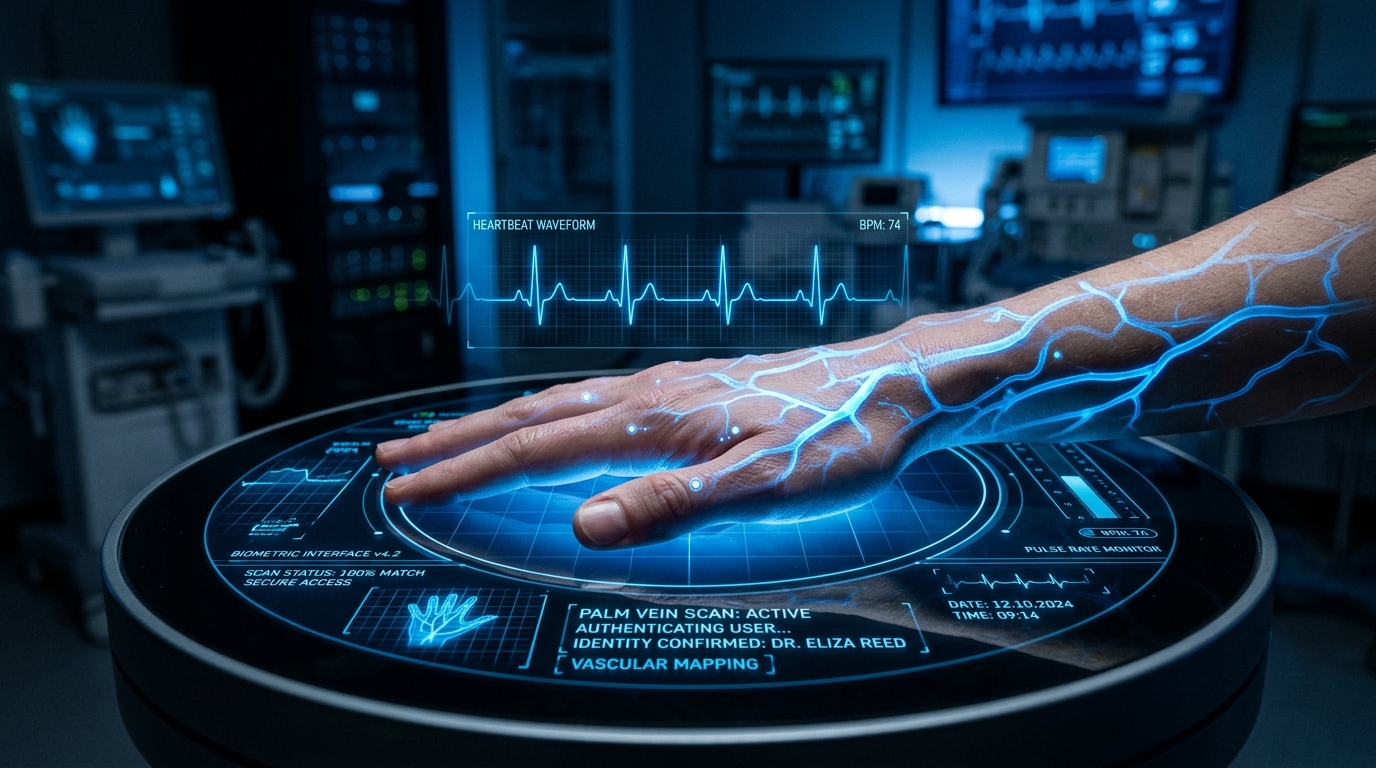
Amazon’s palm recognition system, Amazon One, has emerged as a significant new biometric modality. The system captures an image of the user’s palm — not the surface of the hand (palmprints) but the unique pattern of veins beneath the skin using near-infrared imaging. Vein patterns are extraordinarily unique (even identical twins have different vein patterns), difficult to forge (veins are internal), and stable over time (unlike fingerprints, which can be worn down by manual labor, or faces, which change with age). The vein pattern is converted into a mathematical signature that’s stored encrypted in the cloud, linked to the user’s credit card or Amazon account.
Amazon One is currently deployed at all Whole Foods stores in the US, at Amazon Go stores, and at select stadiums, airports, and entertainment venues. Users enroll by scanning their palm at a kiosk and linking it to a payment method; subsequent transactions require only a palm hover over a reader. The experience is genuinely seamless — no phone, no wallet, no PIN — which Amazon is betting will drive adoption through convenience. As of early 2026, Amazon reports over 15 million enrolled palms.
The privacy implications are significant. Amazon now possesses a biometric database linking unique physical characteristics to purchasing behavior for millions of people. The company’s privacy policy states that palm data is encrypted and can be deleted upon request, but the centralization of biometric identity in a single corporation — particularly one that is also one of the world’s largest advertising and data companies — is a legitimate concern. Biometric data, unlike passwords, cannot be changed if compromised. If your palm vein data is leaked, you can’t get new veins.
Behavioral Biometrics: Your Habits as Your Identity
The most quietly transformative development in biometric authentication is behavioral biometrics — systems that identify users not by a single scan but by continuous analysis of how they interact with their devices. Keystroke dynamics (the rhythm and pressure of your typing), mouse movement patterns, touchscreen gesture characteristics (swipe speed, touch pressure, finger angle), walking gait (measured by phone accelerometers), and even the way you hold your phone all create behavioral signatures that are unique to each individual.
The key advantage of behavioral biometrics is that they operate continuously and passively. Traditional biometric authentication is a one-time gate: you scan your fingerprint to unlock your phone, and then any interaction thereafter is trusted until the phone locks again. Someone who picks up your unlocked phone has full access. Behavioral biometrics, by contrast, continuously monitor whether the person using the device is the person who authenticated. If a different person picks up your phone — typing differently, swiping differently, holding it differently — the system detects the change and can trigger re-authentication or lock sensitive functions.
Banking and financial services are the primary adopters. BioCatch, a behavioral biometrics company, works with over 30 major banks worldwide to detect account takeover fraud and social engineering attacks. The system monitors how a user typically interacts with their banking app — where they tap, how fast they scroll, how long they pause before confirming a transaction — and flags sessions that deviate from the established behavioral pattern. This has proven particularly effective against elder financial abuse, where a scammer may gain physical access to a victim’s phone but cannot replicate their behavioral patterns.
A 2025 study published in the IEEE Transactions on Biometrics found that combining keystroke dynamics, touch gesture analysis, and device motion patterns achieved a 99.7% accuracy in continuous user identification on smartphones — comparable to fingerprint accuracy but without requiring any explicit user action. The technology is maturing rapidly and is expected to be integrated into mobile operating systems within the next few years.
Iris and Retinal Scanning: High Security for High Stakes
Iris recognition — scanning the colored part of the eye using near-infrared imaging — provides perhaps the highest accuracy of any biometric modality. The iris has over 200 unique features (compared to approximately 40 for a fingerprint), and the false match rate for iris recognition systems is less than 1 in 10 million. Unlike the face, the iris pattern is stable from about age 2 through the end of life, making it suitable for lifetime identification.
Iris scanning has historically been limited to high-security environments (border control, military facilities, data centers) due to the need for specialized cameras and controlled positioning of the user. But miniaturization is changing this. Samsung included iris scanning in its Galaxy Note 7 and S8/S9 smartphones (before discontinuing it in favor of face recognition), and several companies are working on iris recognition systems that can capture images at normal distances through standard cameras enhanced with near-infrared LEDs.
The most controversial iris scanning deployment is Worldcoin (now renamed to World), the cryptocurrency and identity project co-founded by OpenAI CEO Sam Altman. World uses custom orbs — metallic spherical devices with specialized cameras — to scan the irises of users and create a cryptographic proof of unique personhood. The stated goal is to provide everyone on Earth with a verified digital identity that can prove they are a real human (not an AI bot) without revealing personal information. Over 10 million people worldwide have been scanned as of 2026.
World has faced intense regulatory scrutiny. Kenya temporarily banned the orbs in 2023 after concerns about data collection practices. Spain, France, Germany, and Portugal have all opened investigations into whether the iris scanning complies with GDPR. The fundamental tension is between the potential utility of a universal proof-of-personhood (increasingly valuable as AI makes it impossible to distinguish human-generated from AI-generated content online) and the profound privacy risks of centralizing iris biometric data for a significant portion of the global population.
The Emerging Frontier: Cardiac Biometrics and Brain Signals
Research labs are exploring biometric modalities that push the boundary of what constitutes an “identity signal.” Cardiac biometrics use radar or infrared sensors to detect the unique rhythm and waveform of a person’s heartbeat at a distance. Unlike a heart rate (which varies with activity and stress), the detailed waveform shape — the specific pattern of electrical impulses and mechanical contractions — is relatively stable and unique to each individual. The Pentagon has developed a laser-based cardiac biometric system (Jetson) that can identify individuals from over 200 meters by their heartbeat — though the technology remains in military applications.
Electroencephalogram (EEG) based authentication uses brain signal patterns as a biometric identifier. Each person’s brain produces unique electrical patterns in response to stimuli, and these patterns are stable enough to serve as authentication factors. While currently requiring specialized headsets (making it impractical for consumer use), the proliferation of consumer brain-computer interfaces — including Meta’s neural wristband and Neuralink’s brain implant — could eventually make brainwave-based authentication viable for mainstream applications.
DNA authentication, while theoretically the ultimate biometric identifier, faces fundamental practical barriers: it requires physical sample collection, takes time to process, and raises the most extreme possible privacy concerns. However, rapid DNA analysis technology has reduced processing time from hours to minutes, and some research labs are exploring whether epigenetic markers that can be read noninvasively (through breath or skin contact) might provide a practical DNA-adjacent biometric modality.
Privacy Laws and Biometric Data
The legal framework around biometric data is evolving faster than the technology itself. Illinois’s BIPA (Biometric Information Privacy Act), passed in 2008, remains the gold standard — it requires explicit informed consent before collecting biometric data, restricts commercial use, mandates data protection standards, and provides a private right of action that allows individuals to sue for violations (with statutory damages of $1,000-$5,000 per violation). BIPA has generated over $1.5 billion in legal settlements, including a $650 million settlement with Facebook/Meta over facial recognition tagging.
Texas, Washington, Colorado, and several other states have enacted biometric privacy laws, though most lack the private right of action that makes BIPA so powerful. The EU’s GDPR treats biometric data as a “special category” requiring explicit consent, and the AI Act adds additional restrictions on real-time biometric identification in public spaces. At the federal level, the US still lacks comprehensive biometric privacy legislation, leaving regulation to a patchwork of state laws.
The core privacy challenge with biometric data is immutability. A stolen password can be reset. A stolen credit card can be replaced. Stolen biometric data cannot be changed — your fingerprints, iris patterns, and vein structures are permanent. This means that biometric data breaches have lifelong consequences, and the security standards for storing biometric data must be commensurately higher. The growing use of on-device processing (where biometric templates never leave the user’s device) and zero-knowledge proofs (where authentication can be verified without transmitting the biometric data) are technical responses to this challenge, but the fundamental risk of centralizing biometric databases remains a defining tension in the field.
Related articles: Fintech Super Apps Dominate Emerging Mar | Neuromorphic Computing: Brain-Inspired C | 3D Bioprinting in 2026: From Lab Curiosi