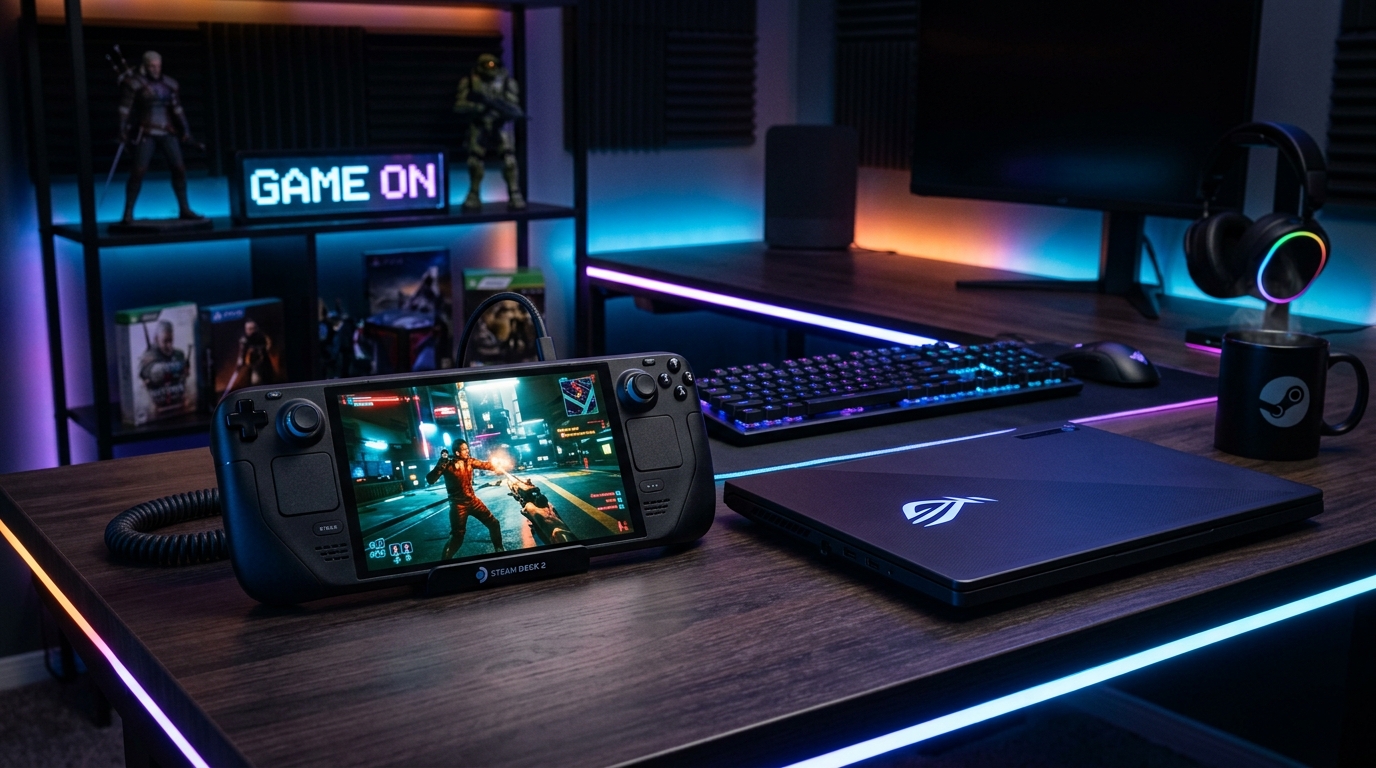
Steam Deck 2 Hands-On: OLED Display, RDNA 4 Graphics, and Desktop-Class Power
Valve revealed the Steam Deck 2 at GDC 2026, and it’s a beast. The handheld gaming PC now packs a custom AMD Zen 5 APU with RDNA 4 graphics, a 7.4-inch Samsung OLED display, and desktop-class performance that can handle current AAA games at native 1080p with high-to-ultra settings — something the original Steam Deck could only dream of through heavy compromises.
Performance That Closes the Gap
The custom “Sephiroth” APU — co-designed by AMD and Valve — features 8 Zen 5 CPU cores and 12 RDNA 4 compute units with hardware ray tracing support. In early benchmarks, it delivers roughly 4x the GPU performance of the original Steam Deck’s Van Gogh chip. Cyberpunk 2077 runs at a stable 60fps at 1080p with medium-high settings and FSR 4 upscaling. Elden Ring hits 60fps with high settings. Even the notoriously demanding Starfield maintains a playable 40-50fps at medium settings.
The 16GB of LPDDR5X unified memory and a high-bandwidth interface to the custom APU eliminate the memory bottleneck that limited the original Steam Deck. Shader compilation stutters — the bane of the SteamOS gaming experience — have been reduced by 90% through a combination of Valve’s shader pre-compilation system and the more powerful hardware handling real-time compilation smoothly.
That OLED Display
The 7.4-inch Samsung OLED display runs at 1080p with a 120Hz refresh rate and supports HDR with 1,000 nits peak brightness. Coming from the original Deck’s 800p LCD (or the OLED model’s 800p OLED), the resolution bump alone makes a dramatic difference in text clarity, UI crispness, and fine detail in games. The HDR capability adds depth to games that support it — HDR-enabled titles like Alan Wake 2 and Spider-Man 2 look phenomenal on the handheld display.
Battery and Design
A 65Wh battery (up from 40Wh) provides 3-5 hours of AAA gaming and 7-10 hours of lighter titles or media playback. That’s roughly comparable to the original Deck despite the significantly more powerful hardware — credit to the 4nm manufacturing process and aggressive power management. 100W USB-C PD charging gets you from 0 to 50% in 30 minutes.
Weight drops slightly to 640 grams (from 669g on the original), achieved through a redesigned internal layout that places the battery closer to the center of the device for better balance. The trackpads retain their haptic feedback but with higher resolution sensors. Hall-effect joysticks replace the original’s potentiometer-based sticks, eliminating drift — the most common hardware failure on portable controllers.
Pricing and Ecosystem
The Steam Deck 2 starts at $499 for the 512GB model and $649 for the 1TB version. There’s no budget SKU this time — Valve said the original 64GB/256GB models taught them that storage-constrained units led to poor user experiences and high return rates. Given that comparable gaming laptops with worse screens cost $1,200+, the Deck 2 is positioned as exceptional value for PC gamers who want a premium portable experience.
Key Aspects
This topic encompasses multiple important dimensions that affect businesses and individuals alike. Understanding each aspect provides valuable perspective on the broader implications.
Market Impact
- Growing adoption across industries
- Significant investment and innovation
- Competitive advantages for early adopters
- New business opportunities emerging
Challenges and Considerations
Implementation requires addressing multiple challenges including technical complexity, organizational readiness, and skill requirements. Success requires commitment to both planning and execution.
Success Factors
Organizations that succeed typically combine strong leadership, adequate resource allocation, clear objectives, and iterative improvement. They also maintain focus on measurable outcomes and ROI.
Looking Ahead
As this technology matures and becomes more mainstream, new opportunities and challenges will emerge. Staying informed and proactive positions organizations for success.
Practical Next Steps
Start by assessing your current position, identifying quick wins, and building momentum. Use early successes to secure support for broader initiatives and organizational change.