Cloud Gaming Latency Drops Below 20ms: The End of the Input Lag Problem
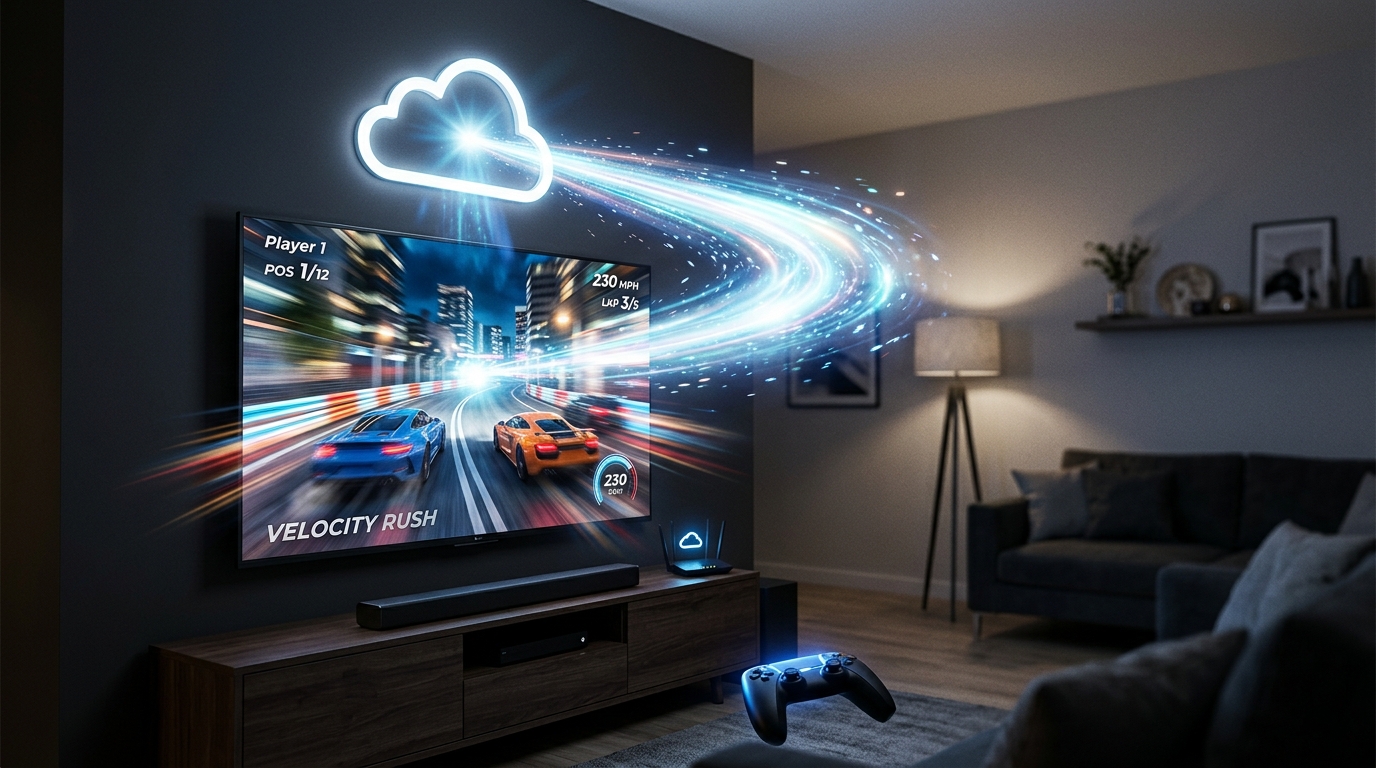
Cloud gaming latency has dropped below 20 milliseconds for the first time on major platforms, effectively closing the gap with local gaming hardware. NVIDIA GeForce NOW, Xbox Cloud Gaming, and Amazon Luna all reported sub-20ms input-to-display latency in early 2026 testing across major metropolitan areas in North America, Europe, and parts of Asia — a threshold that most gamers find indistinguishable from playing on a locally connected console.
How They Got There
The latency breakthrough comes from three converging improvements. First, edge computing deployments have placed game servers within 50 miles of most urban users. NVIDIA now operates over 200 edge server locations in North America alone, compared to roughly 30 regional data centers just two years ago. Less physical distance means fewer milliseconds of network travel time.
Second, new video encoding standards have dramatically reduced the time it takes to compress, transmit, and decode game frames. NVIDIA’s Ada Lovelace encoder chips on their server-side GPUs can encode a frame in under 2 milliseconds using AV1 compression. On the client side, dedicated AV1 decode hardware in phones, tablets, smart TVs, and Chromebooks processes the incoming video stream in another 1-2 milliseconds. The total encode-decode pipeline has been cut from 30ms to under 5ms in optimal conditions.
Third, network protocols have been optimized specifically for real-time gaming. All three major platforms now use custom UDP-based protocols with forward error correction that can tolerate 2-3% packet loss without visible artifacts — compared to standard video streaming that degrades noticeably at 0.5% loss. Adaptive bitrate algorithms predict network congestion 100-200ms in advance and pre-emptively adjust quality to maintain stable latency.
Real-World Testing Results
Digital Foundry’s independent testing measured GeForce NOW at 17.4ms average input lag on a wired gigabit connection in New York — essentially matching the 16.8ms measured when running the same game locally on an RTX 4080 with vsync enabled. Xbox Cloud Gaming averaged 19.2ms in similar conditions. On Wi-Fi 6E connections, latency increased by 3-5ms but remained under 25ms for most testers.
Competitive gaming remains the toughest test case. Professional esports players who require sub-10ms latency won’t be switching to cloud gaming anytime soon. But for the vast majority of gamers playing single-player titles, cooperative games, or casual multiplayer, the current cloud gaming experience is genuinely comparable to local hardware.
Market Implications
When latency stops being a barrier, the value proposition of cloud gaming becomes compelling. NVIDIA GeForce NOW’s $17.99/month Ultimate tier gives users access to RTX 4080 performance — equivalent to a $1,200 GPU — on any device with a screen and internet connection. For gamers who can’t or won’t invest $1,500+ in a gaming PC or $500+ on a console, cloud gaming is now a viable primary gaming platform rather than a compromise.
Analysts at Ampere Analysis project that cloud gaming subscribers will reach 100 million worldwide by 2028, up from 35 million currently. The growth potential is highest in developing markets where local gaming hardware is expensive relative to income but mobile internet infrastructure is rapidly improving.
Architecture and Implementation
Modern infrastructure approaches prioritize scalability, reliability, and cost efficiency. This technology represents a shift in how organizations think about deployment and resource management.
Business Impact
- Significant operational efficiency gains
- Reduced capital expenditure requirements
- Improved time-to-market for new services
- Enhanced security and compliance posture
Adoption Trends
Organizations across sectors are increasingly adopting these approaches. The shift reflects changing priorities around flexibility, scalability, and cost management in IT strategy.
Best Practices
Successful implementation requires careful planning, phased migration strategies, and ongoing optimization. Organizations that invest in proper governance and monitoring see the best results.
Looking Forward
As technology evolves, we can expect continued innovation and broader adoption. Early adopters are already reaping benefits, while others are planning their transitions.
Key Takeaways
This shift in technology represents both challenge and opportunity. Organizations must balance innovation with practical implementation considerations to maximize ROI.