
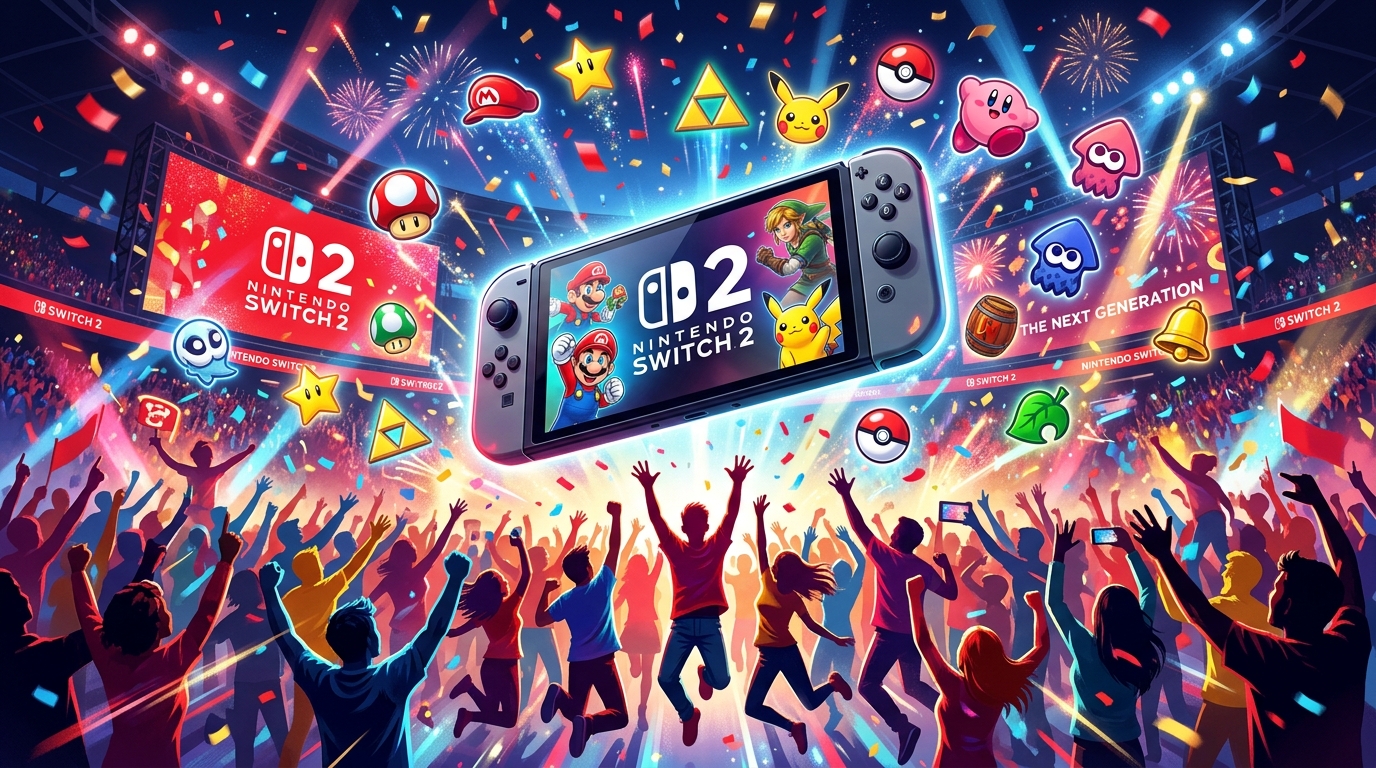
Nintendo Switch 2 Launch Day Review: The Upgrade We’ve Been Waiting For
Nintendo officially launched the Switch 2 on March 28, 2026, and it delivers exactly what fans hoped for: a meaningful hardware upgrade that maintains full backward compatibility with the original Switch’s 5,000+ game library. After a week with the console, the verdict is clear — this is the upgrade the Switch should have gotten years ago.
Hardware and Display
The Switch 2 features a 7.9-inch LCD screen (up from 7 inches on the OLED Switch) running at 1080p — the first time a Switch console has displayed at full HD in handheld mode. The custom NVIDIA T239 processor based on the Ampere architecture delivers roughly 3x the GPU performance of the original Switch, making handheld gameplay look closer to what the Switch could only achieve when docked.
When docked, the Switch 2 outputs up to 4K resolution using NVIDIA’s DLSS upscaling, with games rendering natively at 1080p or 1440p and AI upscaling handling the rest. The result is clean, sharp images on large TVs that finally look competitive with PlayStation and Xbox — though not quite matching the raw power of the PS5 Pro or Xbox Series X.
The Joy-Con controllers have been redesigned with a magnetic attachment system that’s more secure than the original’s slide-and-click mechanism. A new mouse-like sensor on the right Joy-Con enables precision pointing in supported games. Build quality feels substantially improved — the cheap plastic feel of the original Joy-Cons has been replaced with a matte finish and firmer buttons that inspire more confidence.
Launch Games
The launch lineup is anchored by Mario Kart World, an open-world racing game that combines traditional circuits with a freely explorable overworld connecting them. It’s gorgeous running at 60fps in both handheld and docked mode and immediately demonstrates what the new hardware can do. The Legend of Zelda: Echoes of the Wild, Donkey Kong Bananza, and Metroid Prime 4 Beyond round out a first-party launch strategy that’s as strong as any in Nintendo’s history.
Third-party support looks better than expected. Capcom shipped Monster Hunter Wilds as a launch title with performance comparable to last-gen console versions. Ubisoft delivered Assassin’s Creed Mirage, and Bandai Namco brought Elden Ring with a “compromised but playable” 30fps handheld mode that’s remarkable given the game’s scope.
Pricing and Verdict
Nintendo priced the Switch 2 at $449 for the base model — $100 more than the original Switch launch price, reflecting the significant hardware improvements. A bundle with Mario Kart World is available at $499. Given the backward compatibility, strong launch library, and genuine generational improvement, the Switch 2 feels like a compelling upgrade for the 146 million Switch owners worldwide and an easy recommendation for newcomers to Nintendo’s ecosystem.
How This Technology Works
The underlying mechanisms of this technology have evolved significantly. Modern implementations leverage advanced algorithms and machine learning patterns to deliver results at scale.
Key Benefits and Use Cases
- Enterprise-level scalability and performance
- Real-world applications across multiple industries
- Cost-effectiveness compared to traditional approaches
- Future-proof architecture for emerging needs
Challenges and Limitations
While promising, current implementations face several hurdles including integration complexity, resource requirements, and the need for specialized expertise. Organizations must carefully evaluate their readiness before implementation.
What’s Next?
The trajectory suggests continued innovation and adoption. Industry experts predict significant advancements in the coming years as technology matures and becomes more accessible to organizations of all sizes.
Conclusion
Nintendo Switch 2 Launch Day Review: The Upgrade We’ve Been Waiting For represents an important milestone in technological evolution. As the landscape continues to shift, staying informed about these developments will be crucial for businesses and professionals alike.
How This Technology Works
The underlying mechanisms of this technology have evolved significantly. Modern implementations leverage advanced algorithms and machine learning patterns to deliver results at scale.
Key Benefits and Use Cases
- Enterprise-level scalability and performance
- Real-world applications across multiple industries
- Cost-effectiveness compared to traditional approaches
- Future-proof architecture for emerging needs
Challenges and Limitations
While promising, current implementations face several hurdles including integration complexity, resource requirements, and the need for specialized expertise. Organizations must carefully evaluate their readiness before implementation.
What’s Next?
The trajectory suggests continued innovation and adoption. Industry experts predict significant advancements in the coming years as technology matures and becomes more accessible to organizations of all sizes.
Conclusion
Nintendo Switch 2 Launch Day Review: The Upgrade We’ve Been Waiting For represents an important milestone in technological evolution. As the landscape continues to shift, staying informed about these developments will be crucial for businesses and professionals alike.