
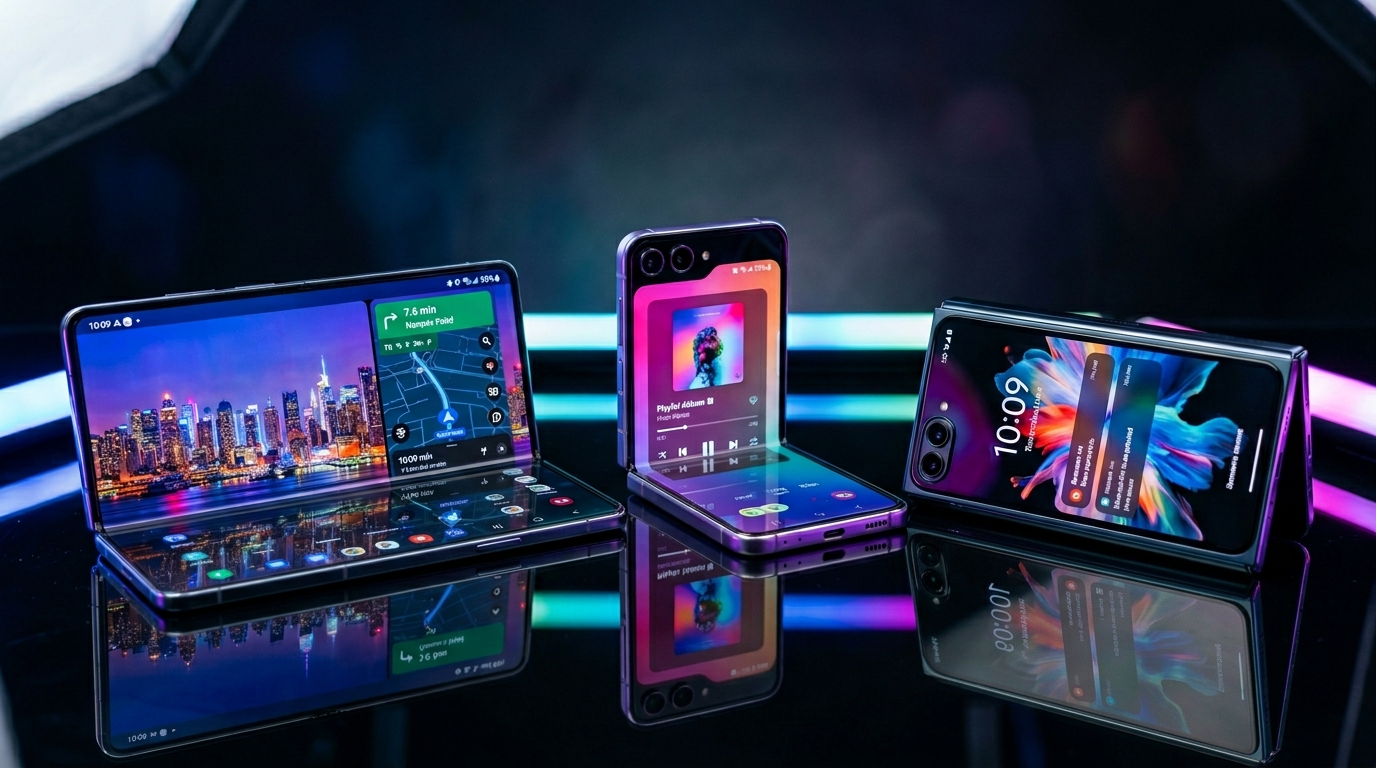
Foldable Phones Finally Go Mainstream with Models Under $500
Foldable phones have finally broken through the price barrier that kept them niche. Samsung, Motorola, and Chinese brands including OPPO and Honor are now shipping foldable smartphones starting under $500, putting a category that debuted at $2,000 just five years ago within reach of mainstream buyers. Global foldable shipments crossed 40 million units in 2025 — and 2026 is projected to hit 65 million.
The Sub-$500 Foldable Lineup
Samsung’s Galaxy Z Flip 6 FE leads the affordable foldable charge at $449. It retains the satisfying clamshell form factor and the outer cover display for quick interactions, while trimming costs through a slightly smaller inner screen (6.5 inches versus 6.7 in the flagship Flip) and last year’s Snapdragon 8 Gen 3 processor — still plenty powerful for daily use. Samsung has sold an estimated 8 million Flip FE units in its first quarter alone.
Motorola’s Razr 50e at $399 offers an even more aggressive price point with a larger 3.6-inch external display that reduces how often you need to open the phone. OPPO’s Find N Flip at $479 brings slimmer bezels and a crease that’s nearly invisible when the display is on — a technical achievement that took years to solve.
For larger book-style foldables, Honor’s Magic V3 Lite at $599 delivers a tablet-sized 7.5-inch inner screen in a package that folds to roughly the size of a regular phone. While not quite under $500, it’s half the price of Samsung’s Galaxy Z Fold 6 at $1,199 — and reviewers note that the everyday performance difference is minimal for most users.
What Changed to Enable These Prices
Making foldables affordable required advances on several fronts. Ultra-thin glass (UTG) — the material that covers foldable screens — has dropped from $80 per panel in 2022 to under $20 as Samsung Display and Corning scaled production. Hinge mechanisms that once required 100+ precision parts now use simplified designs with 60 components that are cheaper to manufacture and more durable, surviving 400,000+ folds without degradation.
OLED display manufacturing yields for foldable panels have improved from 60% in early production to over 90% today, dramatically reducing the effective cost per screen. And competition from Chinese panel makers BOE and CSOT has forced Samsung Display to cut prices to maintain market share — savings that flow through to the final product.
Consumer Adoption Trends
The buyer profile for foldables has shifted dramatically. Early adopters were overwhelmingly tech enthusiasts willing to pay premium prices for novelty. Today, Counterpoint Research data shows that 62% of foldable buyers are upgrading from standard smartphones and cite the larger screen when open plus pocketability when closed as their primary reason — not novelty or status.
App optimization remains the biggest software challenge. While Android 16’s enhanced foldable APIs make it easier for developers to create adaptive layouts, many popular apps still don’t fully utilize the expanded screen real estate when a book-style foldable is opened. Google and Samsung have jointly committed $100 million in developer incentives to accelerate foldable-optimized app development through 2027.
How This Technology Works
The underlying mechanisms of this technology have evolved significantly. Modern implementations leverage advanced algorithms and machine learning patterns to deliver results at scale.
Key Benefits and Use Cases
- Enterprise-level scalability and performance
- Real-world applications across multiple industries
- Cost-effectiveness compared to traditional approaches
- Future-proof architecture for emerging needs
Challenges and Limitations
While promising, current implementations face several hurdles including integration complexity, resource requirements, and the need for specialized expertise. Organizations must carefully evaluate their readiness before implementation.
What’s Next?
The trajectory suggests continued innovation and adoption. Industry experts predict significant advancements in the coming years as technology matures and becomes more accessible to organizations of all sizes.
Conclusion
Foldable Phones Finally Go Mainstream with Models Under $500 represents an important milestone in technological evolution. As the landscape continues to shift, staying informed about these developments will be crucial for businesses and professionals alike.