
3D Bioprinting in 2026: From Lab Curiosity to Printing Human Organs for Transplant
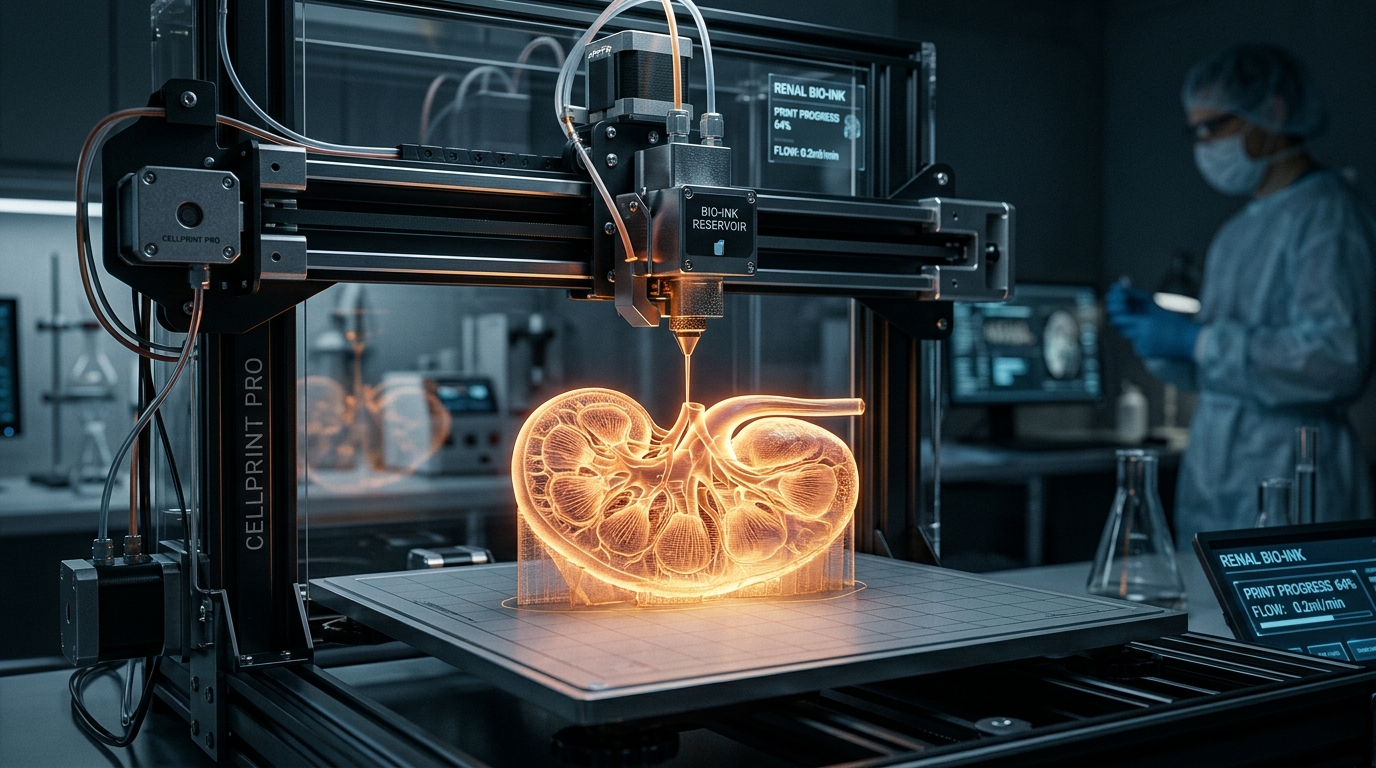
Three-dimensional bioprinting — the process of using modified 3D printers to deposit living cells, biomaterials, and growth factors in precise three-dimensional patterns to fabricate functional biological tissues — has crossed critical milestones in 2026 that bring the prospect of printing human organs from laboratory curiosity to approaching clinical reality. Bioprinted skin grafts are in human clinical trials. Bioprinted cartilage implants have been successfully implanted in patients. Bioprinted liver tissue is being used for pharmaceutical drug testing, replacing animal models. And the first bioprinted full-thickness human organ — a kidney — is projected to enter clinical trials by 2028-2030. The field is moving faster than many in the medical establishment expected.
How Bioprinting Works
Bioprinting adapts the principles of conventional 3D printing (layer-by-layer deposition of material) to biological construction. Instead of plastic filament or metal powder, bioprinters deposit “bioinks” — carefully formulated mixtures of living cells suspended in hydrogel scaffolds (typically made from natural materials like alginate, collagen, fibrin, or decellularized extracellular matrix). The bioink provides structural support while the cells grow, proliferate, and organize into functional tissue.
Three main bioprinting techniques are used. Extrusion bioprinting pushes bioink through a nozzle in a continuous stream, depositing material in the same manner as a conventional FDM 3D printer. It’s the most widely used technique because it can handle high cell densities and viscous bioinks, but resolution is limited (typically 100-500 micrometers). Inkjet bioprinting deposits tiny droplets of low-viscosity bioink with higher resolution (50-100 micrometers) but lower cell density. Laser-assisted bioprinting uses a laser to transfer bioink from a ribbon to a substrate with the highest resolution (single-cell precision) but lowest throughput.
The printing itself is just the beginning. After printing, the construct must be matured in a bioreactor — a carefully controlled environment that provides nutrients, oxygen, mechanical stimulation, and chemical signals that guide the cells to develop into functional tissue. This maturation process can take days to weeks depending on the tissue type. During maturation, the cells remodel their environment, form connections with neighboring cells, develop the specialized structures of their target tissue, and integrate with the hydrogel scaffold (which gradually degrades as the cells produce their own extracellular matrix).
Vascularization — the formation of blood vessel networks that supply nutrients and oxygen to cells deep within the construct — remains the greatest technical challenge. Cells more than 200 micrometers from a blood vessel die from oxygen and nutrient deprivation. For thin tissues (skin, cartilage), direct diffusion provides sufficient nutrients. For thick, metabolically active organs (liver, kidney, heart), an intricate network of blood vessels is essential. Recent advances include printing sacrificial materials that dissolve to leave vessel-like channels, co-printing vascular cells alongside tissue cells, and using growth factors to stimulate natural vessel formation from printed endothelial cells.
Clinical Applications: What’s Working Now
Bioprinted skin is the most clinically advanced application. Several companies and research groups are conducting human clinical trials of bioprinted skin grafts for burn treatment and chronic wound healing. CELLINK’s bioprinted skin constructs contain multiple cell types (keratinocytes, fibroblasts, melanocytes) organized in anatomically correct layers (epidermis over dermis) — a significant improvement over traditional skin grafts, which often lack the layered structure needed for proper healing and cosmetic outcome.
The military medical community has been a significant driver of bioprinted skin research. The US Armed Forces Institute of Regenerative Medicine (AFIRM) has funded bioprinted skin for battlefield burn treatment since 2019. A portable bioprinter that can scan a wound and directly print a customized skin graft in situ (at the bedside rather than in a lab) has been demonstrated in animal models and is being prepared for human trials. The ability to print personalized skin grafts using the patient’s own cells would eliminate the risk of immune rejection and the need for donor skin — both significant limitations of current burn treatment.
Bioprinted cartilage is in early clinical use. Dimension Inx received FDA clearance for a bioprinted nasal septal cartilage implant in 2025 — the first commercially available bioprinted tissue product. The implant is made from a bioink containing the patient’s own chondrocytes (cartilage cells) grown on a 3D-printed scaffold, and it’s used in rhinoplasty and septal reconstruction procedures. The advantage over traditional cartilage grafts (which require harvesting cartilage from the patient’s rib or ear) is reduced surgical complexity and the ability to customize the implant’s shape precisely to the patient’s anatomy.
Bioprinted bone scaffolds are used in reconstructive surgery for treating large bone defects caused by trauma, tumor removal, or congenital abnormalities. These scaffolds are typically printed from biocompatible ceramic materials (hydroxyapatite, tricalcium phosphate) integrated with the patient’s bone marrow-derived stem cells and growth factors. The scaffold provides structural support while the stem cells differentiate into bone cells and gradually replace the scaffold with natural bone tissue. Clinical outcomes have been promising, with several studies showing complete bone regeneration through critical-size defects that would not heal without intervention.
The Organ Printing Frontier
Full organ bioprinting — fabricating a complete, transplantable heart, liver, kidney, or lung — remains the field’s ultimate goal and its greatest challenge. The complexity gap between printing a 2mm-thick skin graft and a 12-centimeter kidney with millions of specialized cells organized in intricate three-dimensional architecture with an integrated vascular network is enormous. But progress toward organ printing is accelerating through several intermediate achievements.
Bioprinted liver tissue is the most advanced organ application, driven by the pharmaceutical industry’s need for accurate drug testing models. Organovo, one of the pioneering bioprinting companies, produces bioprinted liver tissue (exVive3D) that metabolizes drugs and produces toxicity responses comparable to actual human liver tissue — far more accurate than the animal models traditionally used in drug development. Multiple pharmaceutical companies use bioprinted liver tissue for preclinical drug safety testing, reducing animal testing and providing more human-relevant data. The path from drug testing tissue to transplantable liver is long but the fundamental biology is being explored.
Israeli researchers at Tel Aviv University have bioprinted a miniature heart (approximately the size of a rabbit’s heart) complete with blood vessels, using the patient’s own cells and biological materials. While the printed heart couldn’t pump blood (the cardiomyocytes didn’t yet contract synchronously), the achievement demonstrated that complex cardiac anatomy could be recreated through bioprinting. Subsequent work has focused on electrical coupling of printed cardiomyocytes and development of functional contractile tissue.
Kidney bioprinting is considered the most impactful potential organ application because kidney failure affects 850 million people globally, over 100,000 patients in the US alone wait for kidney transplants (with many dying on the waiting list), and dialysis — the current treatment for kidney failure — costs $90,000 per patient per year and provides only partial kidney function replacement. A bioprinted kidney would transform treatment of the disease. Several research groups have printed functional nephron-like structures (the kidney’s basic filtration units), and the challenge is scaling from individual nephrons to the millions needed in a complete kidney.
The Cell Source Challenge
Every bioprinted tissue requires cells, and the source and quality of those cells significantly affects the outcome. Autologous cells (the patient’s own cells) provide the best immunological compatibility but require harvesting, expansion in culture, and sometimes reprogramming — processes that take weeks and add cost. Allogeneic cells (from donors) are more readily available but risk immune rejection, potentially requiring immunosuppressive drugs that negate some of the advantages of bioprinted tissue over traditional transplants.
Induced pluripotent stem cells (iPSCs) represent the most promising cell source for organ bioprinting. iPSCs are adult cells (typically skin or blood cells) that have been reprogrammed to a stem-cell-like state capable of differentiating into any cell type. From a patient’s skin biopsy, iPSCs can theoretically generate cardiomyocytes for a heart, hepatocytes for a liver, podocytes for a kidney, or any other specialized cell type — all genetically matched to the patient and thus immune-compatible. The challenge is the reliability and efficiency of iPSC differentiation protocols, which are improving but not yet consistent enough for routine clinical use.
Cell expansion at scale is another bottleneck. Bioprinting a liver requires billions of hepatocytes; a kidney requires millions of podocytes, tubular cells, and endothelial cells. Growing these quantities of cells from biopsied samples takes weeks in current culture systems. Bioreactor-based cell expansion — automated, scalable cell culture in controlled conditions — is being developed to reduce this timeline, with several companies offering industrial-scale cell expansion services specifically for tissue engineering and bioprinting applications.
Regulatory and Ethical Landscape
Bioprinted tissues and organs occupy a novel regulatory category that existing frameworks were not designed to handle. In the US, the FDA regulates bioprinted products through multiple centers depending on the product’s characteristics: CBER (Center for Biologics Evaluation and Research) for products primarily composed of living cells; CDRH (Center for Devices and Radiological Health) for products that function primarily as structural devices; and sometimes both centers jointly for products that combine device-like scaffolds with biological components.
The FDA’s Regenerative Medicine Advanced Therapy (RMAT) designation, created by the 21st Century Cures Act, provides an expedited review pathway for regenerative medicine products including bioprinted tissues. Several bioprinted products have received RMAT designation, enabling faster clinical trial approval and closer FDA engagement during development. The Tissue Engineering and Regenerative Medicine International Society (TERMIS) has published guidance documents for regulatory submission of bioprinted products, helping standardize the process across different countries.
Ethical considerations are relatively straightforward for bioprinted tissues using the patient’s own cells (autologous therapy has minimal ethical objections). More complex ethical questions arise around commercial bioprinted organs: who has access if supply is limited? Will cost create a two-tier medical system where the wealthy receive bioprinted organs while others remain on transplant waiting lists? How do we handle the intellectual property of organ designs — can a company patent a heart? These questions are being considered by bioethicists and policymakers, but the field’s clinical immaturity means most are still theoretical rather than immediate.
Timeline and Expectations
Realistic timelines for bioprinting milestones, based on current progress and expert projections: bioprinted skin grafts and cartilage implants are in clinical use now and will become routine within 3-5 years. Bioprinted bone grafts for large defect reconstruction will achieve broader clinical adoption within 5-7 years. Bioprinted vascularized tissue patches (for cardiac repair, liver support) will enter clinical trials within 5-8 years. The first bioprinted full organ transplant (likely a kidney or liver segment) will enter clinical trials within 8-12 years, with routine availability likely 15-20 years away.
These timelines may accelerate through convergence with other technologies: AI-optimized bioink formulations, high-throughput cell expansion bioreactors, real-time multi-sensor quality monitoring during printing, and machine learning-guided maturation protocols that optimize bioreactor conditions for each construct. The field is moving from artisanal craftsmanship (each printed construct is a unique experiment) toward reproducible manufacturing (consistent, scalable production of validated tissue products) — a transition essential for clinical adoption and regulatory approval at scale.
Related articles: Fintech Super Apps Dominate Emerging Mar | Neuromorphic Computing: Brain-Inspired C | 3D Bioprinting in 2026: From Lab Curiosi