The AI Music Copyright War: Lawsuits, Artists’ Rage, and the Future of Creative AI Rights
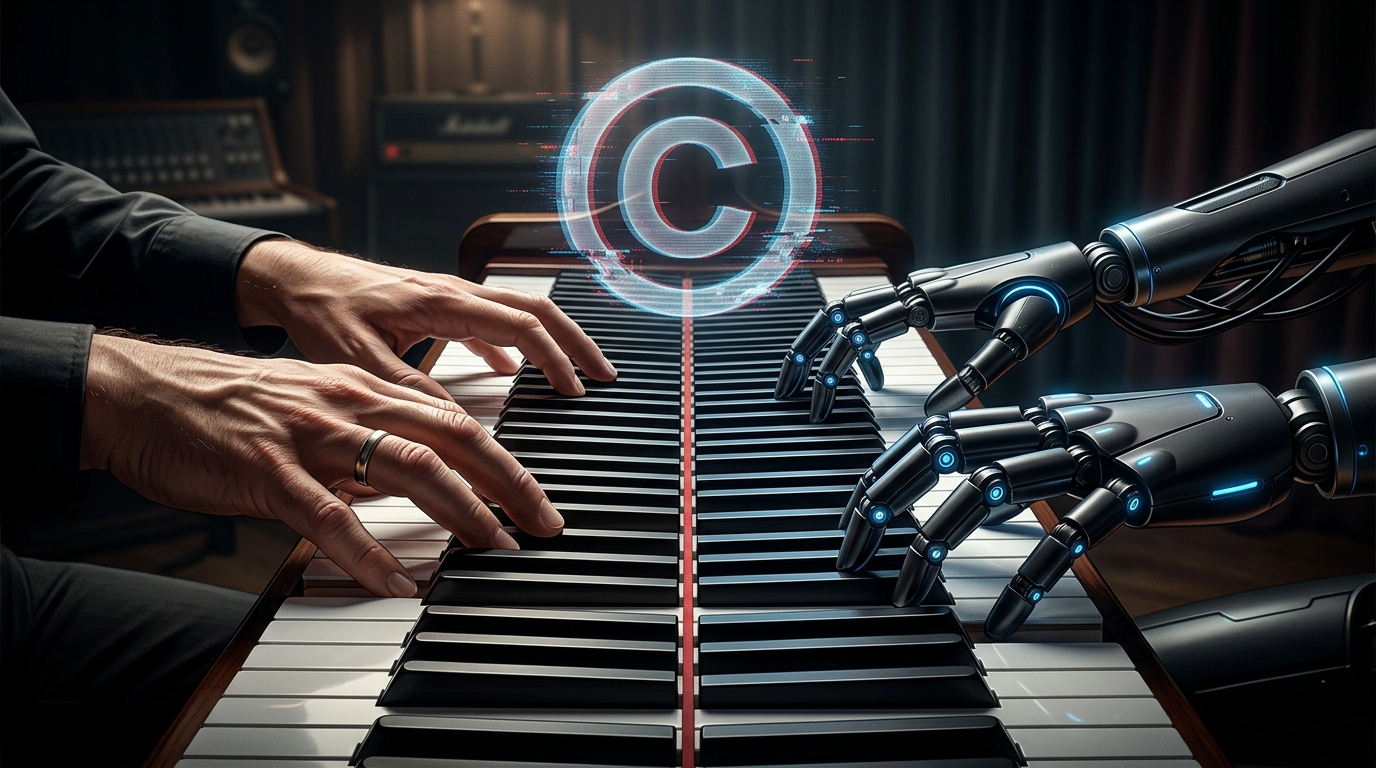
The AI-generated music industry is heading for a legal reckoning that will define the boundaries of artificial intelligence creativity for decades. Major record labels, music publishers, and artist bodies are locked in an escalating series of lawsuits against AI music generation companies — Suno, Udio, Stability Audio, and others — that fundamentally challenge whether AI systems can be trained on copyrighted music and whether the output they produce constitutes infringement. The outcome will determine not just the future of AI music but establish precedents that extend to AI-generated art, writing, video, and code.
How AI Music Generation Works
Modern AI music generators work by training neural networks on massive datasets of existing music. The AI learns the statistical patterns of music — chord progressions, melodic structures, rhythmic patterns, production techniques, genre conventions, and even the sound characteristics of specific instruments and vocal styles. Once trained, the model can generate new music from text prompts: “upbeat indie rock song with female vocals about summer road trips” produces a complete track with vocals, instruments, and production that sounds like it could have been recorded by a real band.
The quality of AI-generated music has improved dramatically in the past two years. Suno and Udio, the two leading consumer-facing AI music generators, produce songs that are indistinguishable from human-created music to most casual listeners. Full-length tracks with coherent lyrics, natural-sounding vocals, genre-appropriate production, and emotional dynamics are generated in under 60 seconds. The technology has moved well beyond novelty — AI-generated tracks are being used in YouTube videos, podcasts, indie games, social media content, and even released on streaming platforms as commercial releases.
The training data question is at the heart of the legal dispute. These AI models were trained on vast quantities of copyrighted music — potentially millions of songs from commercial releases, streaming platforms, and online sources. The AI companies argue that this training constitutes fair use, analogous to how a human musician listens to thousands of songs and absorbs influences before creating original work. The music industry argues that training on copyrighted music without permission or payment is unauthorized reproduction, regardless of whether the AI’s output contains directly copied elements.
The Legal Battles
The Recording Industry Association of America (RIAA), representing major labels Universal Music Group, Sony Music, and Warner Music Group, filed landmark lawsuits against both Suno and Udio in June 2024. The complaints allege that both companies trained their AI models on copyrighted recordings without authorization and that the resulting generated music contains elements substantially similar to specific copyrighted works. The RIAA claims statutory damages of $150,000 per work infringed — a figure that, multiplied across millions of potentially infringed recordings, represents billions of dollars in potential liability.
The labels’ evidence includes demonstrations where prompting AI music generators with specific song titles, artist names, or distinctive lyrical phrases produces output that closely resembles identifiable copyrighted works. In internal testing, researchers found that prompting Suno to generate a song “in the style of [famous artist]” could produce tracks with melodic phrases, vocal characteristics, and production elements that an expert listener would identify as derived from specific copyrighted recordings. Whether this constitutes legal infringement or is analogous to how human musicians create work influenced by their predecessors is the central legal question.
Suno and Udio’s defense centers on the fair use doctrine, arguing that training AI on copyrighted material is transformative use protected by the First Amendment. They point to legal precedent from Google v. Oracle (where the Supreme Court ruled that Google’s use of Java API declarations was transformative fair use) and Authors Guild v. Google (where Google’s digitization of library books for search indexing was found to be fair use). The argument is that AI training extracts general patterns and knowledge from copyrighted works but doesn’t reproduce them — the AI creates genuinely new expressions based on learned concepts.
The music industry’s position is that AI music generation is fundamentally different from the search indexing at issue in Google’s cases. AI music generators don’t just index or reference copyrighted works — they produce competitive substitutes. An AI-generated “indie folk song with acoustic guitar and breathy female vocals” directly competes with actual indie folk recordings in the marketplace. This substitution effect undermines the copyright holders’ economic interest in a way that Google’s book search did not.
The Human Artist Perspective
The reaction from human musicians and songwriters has been overwhelmingly negative, driven by both economic concerns and philosophical objections about the nature of creativity. Over 30,000 artists — including Billie Eilish, Nicki Minaj, Stevie Wonder, Katy Perry, Smokey Robinson, and hundreds of other prominent musicians — signed an open letter organized by the Artist Rights Alliance calling for protections against “predatory use” of AI in music and demanding that AI companies not use copyrighted material for training without consent and compensation.
The economic concern is straightforward: if AI can generate acceptable music at near-zero marginal cost, the market for human-created music in certain categories will shrink. Background music for videos, podcasts, games, and advertising — categories that represent billions in annual licensing revenue — is particularly vulnerable because quality requirements are lower (background music doesn’t need to be brilliant, just appropriate) and cost sensitivity is high (content creators prefer free or cheap background music). If AI-generated tracks are available at a fraction of the cost of licensed human recordings, rational economic actors will choose the AI option.
The philosophical objection is that music is a form of human expression that derives its value from the human experience behind it. A love song written by a person who’s experienced heartbreak carries emotional weight that AI — which has never experienced love or loss — cannot genuinely replicate, even if the acoustic output sounds similar. This perspective holds that AI music is imitation without understanding, form without substance, and that proliferating it degrades the cultural value of music itself.
Some artists take a more pragmatic view, seeing AI as a tool rather than a threat. AI can generate backing tracks, suggest chord progressions, create demos, and handle production tasks that speed up the creative process. Human creativity still directs the artistic vision, makes the aesthetic judgments, and provides the emotional authenticity — AI accelerates the execution. This tool-use perspective is similar to how many visual artists view AI image generators: threatening when used as a wholesale replacement, useful when used as a creative assistant.
The Platform Response
Streaming platforms are grappling with how to handle AI-generated music. Spotify, Apple Music, Amazon Music, and other platforms host millions of AI-generated tracks — some transparently labeled, many not. The economics for platforms are nuanced: AI-generated tracks fill streaming catalogs at no cost (no advance payments, no artist development investment), and when consumers stream them, the platform pays a fraction of a cent per stream from the same royalty pool shared with human artists. This means AI-generated streams dilute the royalty payments to human musicians — a phenomenon that the music industry calls “royalty dilution.”
Spotify has taken the most aggressive stance, removing tens of thousands of AI-generated tracks uploaded by companies trying to game streaming royalties by flooding the platform with synthetic music. Spotify’s policy requires that AI-generated music not impersonate existing artists and that uploaders have the rights to distribute the content. Apple Music has been more permissive, accepting AI-generated content as long as distribution rights are clear. YouTube’s policy permits AI-generated music but provides tools for rights holders to claim or remove content that uses their copyrighted material without authorization.
Universal Music Group and other major labels have demanded that streaming platforms prevent AI companies from scraping their catalogs for training data and that AI-generated music be clearly labeled so consumers can make informed listening choices. Some labels have experimented with authorized AI collaborations — Warner Music’s partnership with Endel for AI-generated ambient music, and Universal’s deal with YouTube for AI music tools that respect copyright — suggesting that the industry isn’t entirely opposed to AI music, just to AI music that uses their catalogs without permission or payment.
The Regulatory Landscape
Governments worldwide are developing regulatory frameworks for AI-generated creative content. The EU AI Act requires that AI systems disclose when content is AI-generated and mandates transparency about training data. The proposed EU Copyright Directive amendments would require AI companies to obtain licenses for copyrighted training data unless an explicit opt-out mechanism is available. In the US, copyright law is evolving through litigation rather than legislation — the Copyright Office has ruled that purely AI-generated works cannot receive copyright protection (because copyright requires human authorship), but the boundaries of “AI-assisted” versus “AI-generated” remain undefined.
China has taken a different approach, requiring that AI-generated content be watermarked and that AI training data comply with Chinese copyright law. The practical effect is that Chinese AI music companies must either license training data or rely on public domain material. Japan’s copyright law includes a broad exception for AI training that is more permissive than US or EU law, making Japan an attractive jurisdiction for AI model training — though the application of this exception to commercial AI music generation has not been tested in court.
Where This Ends Up
The most likely outcome is a licensing framework that compensates copyright holders for AI training use while permitting AI music generation to continue. This parallels the resolution of previous music technology disruptions: when radio, jukeboxes, digital downloads, and streaming each threatened existing music industry business models, the resolution was a licensing framework that redistributed revenue rather than prohibiting the technology. ASCAP, BMI, and SESAC’s blanket licensing model for public performance, and the mechanical licensing system for recordings, provide templates for how an AI training license might work.
Several proposals are on the table. Some advocate for a collective licensing scheme where AI companies pay into a fund that’s distributed to rights holders proportional to their catalog’s representation in training data. Others propose a per-generation royalty where AI companies pay a small fee for each generated track, similar to how streaming services pay per-stream royalties. Still others suggest that AI companies should negotiate individual licenses with each rights holder, similar to how sampling clearances work — though this approach would be logistically impractical given the millions of works involved in training data.
Whatever licensing framework emerges, AI music generation is not going away. The technology is too useful, too capable, and too demanded by content creators who need affordable music for their projects. The question is whether the framework adequately compensates the human musicians whose work made the technology possible, and whether it preserves the economic viability of human music creation in a world where AI can produce acceptable substitutes at near-zero cost. The answer will be determined by a combination of court rulings, legislation, industry negotiations, and the choices of millions of consumers about whether they value human creativity enough to pay a premium for it.
Related articles: Fintech Super Apps Dominate Emerging Mar | Neuromorphic Computing: Brain-Inspired C | 3D Bioprinting in 2026: From Lab Curiosi