
The VPN Industry Shakeup: Privacy Laws, Quantum Threats, and the Death of the Corporate Tunnel
The VPN industry is undergoing a fundamental transformation driven by tightening privacy regulations, evolving cybersecurity threats, and a user base that increasingly demands more than just IP masking. What started as a simple tool to encrypt traffic and hide location has become a complex product category spanning consumer privacy, enterprise zero-trust architecture, and geopolitical censorship circumvention. The global VPN market, now worth $75 billion, is being reshaped by regulatory pressure from multiple directions — governments that want to mandate encryption standards, while simultaneously wanting the ability to surveil encrypted communications.
The Regulatory Squeeze
VPN providers are caught between competing regulatory demands across jurisdictions. The European Union’s GDPR and the newer Digital Services Act (DSA) impose strict requirements on data handling and user privacy — requirements that most reputable VPN providers already meet through their no-logs policies. But at the same time, law enforcement agencies in the EU, UK, US, and especially in countries like India and Russia are pushing for regulations that would require VPN providers to retain user connection logs and provide them to authorities upon request.
India’s CERT-In directive, which went into effect in 2022, requires VPN providers operating in India to maintain user logs for five years — including real names, IP addresses, usage patterns, and reason for using the VPN. Several major VPN providers (ExpressVPN, NordVPN, Surfshark, ProtonVPN) responded by removing their physical servers from India and instead offering “virtual India” servers located in Singapore or the UK that assign Indian IP addresses. This cat-and-mouse dynamic is playing out globally as privacy law and surveillance law collide.
Russia has gone further, outright banning consumer VPNs that don’t register with the government and integrate with the state’s censorship infrastructure. China’s Great Firewall has sophisticated deep packet inspection that can identify and block most VPN protocols. Iran and Myanmar block VPN traffic during political unrest. The consequence is a two-tier VPN market: one for countries with rule of law and privacy protections, and another for countries where VPN use is an act of political resistance requiring increasingly sophisticated obfuscation technology.
In the United States, the regulatory environment is more ambiguous. No federal law requires VPN providers to retain logs, and the FTC has actually taken enforcement action against VPN providers that claimed no-logs policies but actually collected data. However, the EARN IT Act and FISA Section 702 reauthorization create legal mechanisms for the government to compel data disclosure from service providers, and VPN providers are not explicitly exempt. The legal gray area creates risk for both users and providers.
The Technical Evolution: Beyond Simple VPNs
Traditional VPNs work by establishing an encrypted tunnel between the user’s device and a VPN server. All internet traffic is routed through this tunnel, hiding the user’s IP address and preventing the ISP from inspecting traffic content. This fundamental mechanism hasn’t changed, but the technology stack around it has evolved dramatically.
WireGuard, the modern VPN protocol that has largely displaced OpenVPN and IPsec for consumer use, provides faster connections, better battery life on mobile devices, and a simpler codebase that reduces security vulnerabilities. WireGuard’s approximately 4,000 lines of code (compared to OpenVPN’s roughly 100,000 lines) makes it far easier to audit for security issues. Most major VPN providers now use WireGuard as their default protocol, often wrapped in proprietary implementations (NordVPN’s NordLynx, ExpressVPN’s Lightway is WireGuard-inspired) that add features like dynamic IP assignment and key rotation.
Multi-hop (or double VPN) routing, which sends traffic through two or more VPN servers in different countries, provides additional protection against surveillance. If one VPN server is compromised, the attacker only sees encrypted traffic going to another VPN server rather than the user’s actual destination. ProtonVPN’s Secure Core routes traffic through privacy-friendly jurisdictions (Iceland, Switzerland, Sweden) before exiting to the wider internet, providing legal and physical protection for the intermediate hop.
The most significant technical development is the integration of post-quantum cryptography into VPN protocols. As discussed in the broader post-quantum migration, recorded VPN traffic could potentially be decrypted by future quantum computers. Given that VPN users include journalists, activists, corporate executives, and government officials — people whose communications may be targeted for “harvest now, decrypt later” attacks — quantum-resistant encryption in VPN tunnels is not theoretical paranoia but practical security hygiene. Mullvad VPN and ProtonVPN have already deployed post-quantum key exchange for WireGuard connections, with other providers following.
Consumer VPN Market Consolidation
The consumer VPN market has consolidated dramatically. Kape Technologies (parent of ExpressVPN, CyberGhost, and Private Internet Access) and Nord Security (parent of NordVPN, Surfshark, and Atlas VPN) together control an estimated 60% of the consumer VPN market. This concentration raises concerns among privacy advocates — the entire point of a VPN is to trust the provider with your traffic, and having fewer independent providers means fewer options for users who need high-assurance privacy.
The consolidation is partly driven by the economics of consumer VPN marketing. Acquiring users through online advertising, sponsorship deals (VPN companies are among the largest sponsors of YouTube channels and podcasts), and app store placement requires significant capital. Smaller VPN providers struggle to compete for visibility against well-funded competitors spending tens of millions annually on marketing. The result is a market where the best-known brands aren’t necessarily the most private or secure — they’re the ones with the biggest marketing budgets.
Independent privacy-focused VPN providers continue to serve the most demanding users. Mullvad VPN, based in Sweden, accepts cash payments by mail and doesn’t require an email address for signup — providing near-anonymous VPN access for users who can’t afford any metadata trail. IVPN, based in Gibraltar, publishes annual transparency reports and has undergone multiple independent security audits. ProtonVPN, operated by the same team behind ProtonMail, benefits from Switzerland’s strong privacy laws and a reputation built on the encrypted email service. These providers prioritize privacy over market share, serving a niche but critical user base.
Enterprise VPN: From Always-On Tunnel to Zero Trust
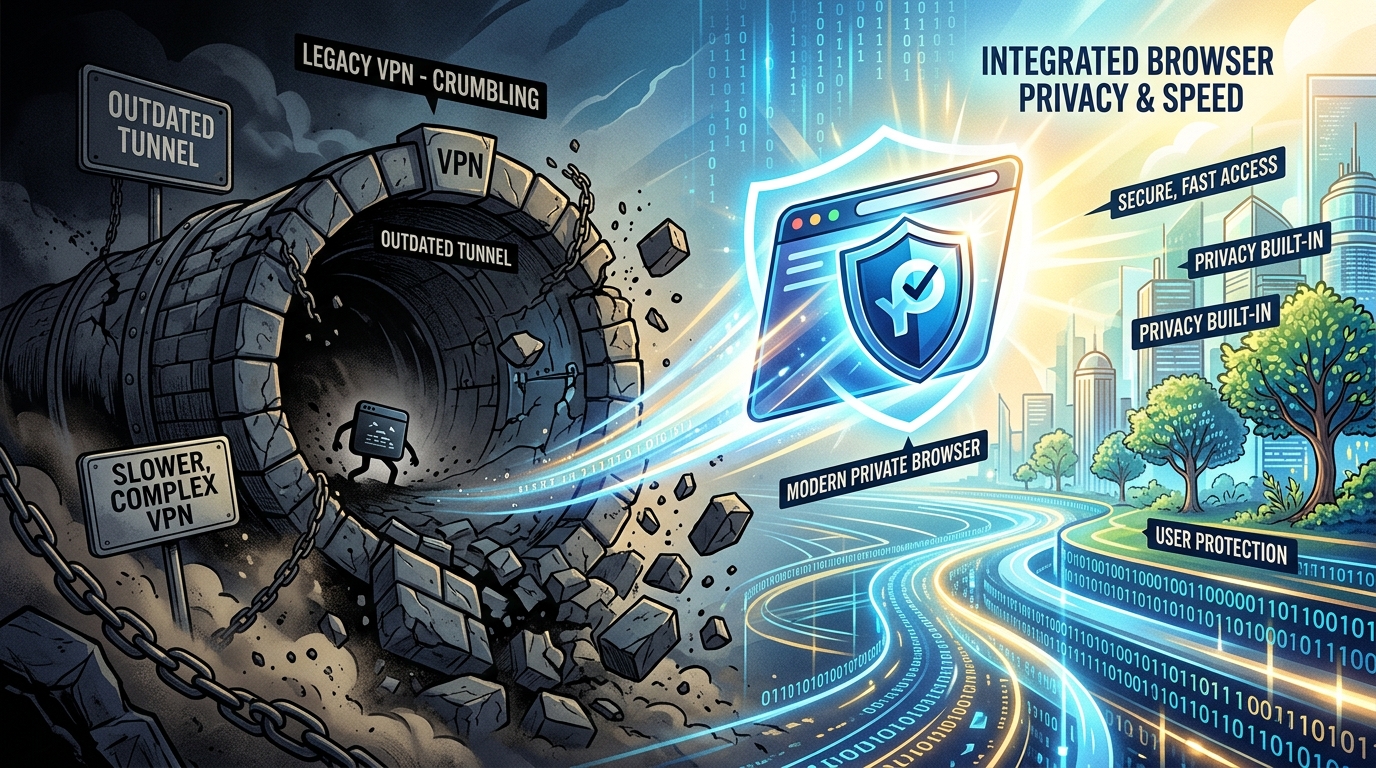
In the enterprise market, the traditional “always-on tunnel” VPN — where remote employees connect through a VPN concentrator to access the corporate network — is being replaced by zero-trust network access (ZTNA). The concept behind ZTNA is that connecting to a network should not automatically grant access to resources on that network. Instead, every access request is authenticated, authorized, and encrypted individually, regardless of whether the user is on the corporate network, on a VPN, or at a coffee shop.
The shift was accelerated by the pandemic-era mass move to remote work, which exposed the limitations of traditional VPN architecture. When thousands of employees simultaneously connect through a VPN concentrator, bandwidth becomes a bottleneck. When all traffic is routed through headquarters (split tunneling disabled), latency increases and the VPN server becomes a single point of failure. When any device with VPN credentials can access the entire corporate network, a compromised laptop becomes a network-wide security incident.
ZTNA solutions from Zscaler, Cloudflare, Palo Alto Networks, and others replace the network-level VPN tunnel with application-level access proxies. An employee accessing a corporate application doesn’t connect to the corporate network — they authenticate to the proxy, which verifies their identity, device health, and authorization for the specific application before forwarding the request. The employee never has network-level access; they have application-level access, granted per-session based on real-time risk assessment.
Gartner estimates that by 2027, ZTNA will be the primary remote access method for 70% of new enterprise deployments, up from approximately 20% in 2023. The traditional enterprise VPN isn’t disappearing immediately — legacy applications that require network-level access, regulatory requirements for encrypted tunnels, and the inertia of existing deployments will sustain VPN usage for years. But for new deployments, the directional shift toward ZTNA is decisive.
The Free VPN Problem
Free VPN services remain one of the most dangerous categories of consumer software. Multiple studies have found that free VPNs frequently engage in the very behaviors they claim to prevent: logging user activity, injecting advertising into browsing sessions, selling bandwidth to botnets, and even installing malware. A 2025 study by Top10VPN analyzed 150 popular free VPN apps on Android and found that 72% contained at least one tracking library, 38% contained malware signatures, and 18% failed to encrypt traffic at all despite claiming to do so.
The business model of most free VPNs is straightforwardly predatory: they monetize users’ data and bandwidth because they have no subscription revenue to sustain operations. Some free VPNs are operated by data brokers who collect and sell browsing data. Others sell users’ bandwidth as residential proxy traffic — used by marketers, scrapers, and potentially cybercriminals. The maxim “if you’re not paying, you’re the product” is nowhere more literally true than in the free VPN market.
Reputable VPN providers offer free tiers with limited functionality — ProtonVPN’s free tier provides servers in five countries with no data cap, and Windscribe offers 10GB monthly free. These legitimate free options are vastly outnumbered by predatory free VPN apps in app stores, and the average consumer cannot distinguish between them. App store operators (Apple and Google) have been criticized for insufficient vetting of free VPN apps, though both have tightened requirements in recent years.
The Road Ahead
The VPN industry’s future is being shaped by a fundamental tension: encryption is simultaneously mandated (for data protection) and threatened (by surveillance-focused regulations). Providers are navigating this tension by investing in transparency (independent audits, open-source clients, warrant canaries), technical innovation (post-quantum encryption, decentralized VPN architectures, multi-hop routing), and legal strategy (incorporating in privacy-friendly jurisdictions, fighting data retention mandates in court).
The emergence of decentralized VPN (dVPN) networks — where traffic is routed through nodes operated by independent individuals rather than a single corporate provider — represents the most radical potential evolution. Projects like Orchid, Mysterium, and Sentinel operate VPN-like services on decentralized infrastructure, theoretically eliminating the single point of trust (and failure) that traditional VPN providers represent. Whether dVPN can deliver the reliability and performance that mainstream users expect is an open question, but the concept addresses the fundamental trust problem at the heart of VPN usage.
For everyday users, the practical recommendation remains straightforward: if you use the internet, a reputable paid VPN is a reasonable privacy investment. Not because it makes you anonymous — it doesn’t — but because it prevents your ISP from logging your browsing history and selling it to advertisers, it encrypts your traffic on public Wi-Fi networks, and it provides a layer of protection against network-level surveillance. As privacy regulations evolve and quantum computing advances, the importance of encrypted communication will only increase — and VPNs, in whatever form they take, will remain a core tool in the privacy toolkit.
Related articles: Fintech Super Apps Dominate Emerging Mar | Neuromorphic Computing: Brain-Inspired C | 3D Bioprinting in 2026: From Lab Curiosi